


- May 30 2009: Updated & (hopefully) improved with thanks to Ralph’s comment.
- January 10 2012 Updated with Shelley’s Bodleian manuscript and further discussion of the mysterious eighth line.
- Be sure and read the comments! Much is discussed, many helpful and insightful comments have been made. You’ll be missing the better half of the post if you skip them. :-)
Who was Ozymandias?

When I first read this poem as a high school student I thought that Ozymandias was Shelley’s own creation. But, as always, truth is sometimes more surprising than fiction.
Shelley wrote Ozymandias in 1817 in friendly competition with another friend and poet – Horace Smith. Wikipedia offers up a good article on the poem, from which the photo at left is taken.
Rather than reinvent the wheel, here’s what Wikipedia has to say (links and all): “Ozymandias was another name for Ramesses the Great, Pharaoh of the nineteenth dynasty of ancient Egypt. Ozymandias represents a transliteration into Greek of a part of Ramesses’ throne name, User-maat-re Setep-en-re. The sonnet paraphrases the inscription on the base of the statue, given by Diodorus Siculus as “King of Kings am I, Osymandias. If anyone would know how great I am and where I lie, let him surpass one of my works.”
Some scholars, the article continues, dispute whether Shelley actually saw the statue before writing the sonnet. (It arrived in England after the sonnet’s publication.) Given the fame of the statue, however, Shelley was probably already familiar with it through description and illustration.
The poem was later published by Liegh Hunt, January 1818, in the Examiner, then reprinted again with Rosalind and Helen in 1819.
 November 2 2011 • Another blogger The Era of Casual Fridays (and a favorite of mine) just recently posted on Ozymandias. Mark’s analysis tend to focus more on the historical context of the poems (whereas I enjoy interpretation and analysis). You will find much information that I didn’t discuss or mention (what sources inspired Shelley for example). Mark’s post is rich with information.
About the Sonnet
The copy of the poem I’ve used in my scansion is based on the version published in Oxford University’s The Complete Poetical Works of Percy Bysshe Shelley. I’ve noticed that the punctuation differs from those of other versions on the net. All unmarked feet are iambic. Red denotes a trochaic foot. Yellow denotes a phyrric foot (though, in each, I’ve marked the second syllable as an intermediate stress).

- I hear this sonnet a little different than most – so I put this recording together. This reading comes with a little context at the beginning. See what you think.
The background is from The Free Music Archive and the music is offered under the Creative Commons License.
Most would probably consider this a Nonce Sonnet. Nonce refers to any poetic form in which the rhyme scheme is made up by the poet. Technically, Shelley’s rhyme scheme is a nonce sonnet.  However, apart from the rhymes, things/Kings, the sonnet is close enough to the Petrarchan rhyme scheme to be a minor variation. Ultimately, it only matters if you’re curious about Shelley as a craftsman. My guess is that he set out to write a Petrarchan Sonnet but, in competition with a friend and writing quickly, he decided to make do with the rhyme scheme that most easily flowed from his pen. But that’s only conjecture.
The sonnet is written in Iambic Pentameter; and if you’re not sure what that means or the symbols used to scan the sonnet, check out my post on Iambic Pentameter and the Basics.
Shelley’s metrical variants are well-placed – Stand, Tell, stamped, Look, followed by Nothing and boundless. The trochaic placement of Stand, whether intentional or not, adds emphasis to the implacable fact of the statue’s “trunkless legs”. The trochaic placement of stamp, as with stand, only adds emphasis to the hard, unforgiving, presence. In the final quatrian, Look, aurally and subliminally, is heard in association with the trochaic Nothing and boundless. The meter reinforces the bleak, hard cruelty of the subject matter. The Sonnet is a masterpiece.
Interpreting the Sonnet
I met a traveller from an antique land
Who said: “Two vast and trunkless legs of stone
Stand in the desert… Near them, on the sand,
Half sunk, a shattered visage lies, whose frown
And wrinkled lip and sneer of cold command
Tell that its sculptor well those passions read
Which yet survive, stamped on these lifeless things,
These first 7 lines are deceptively straightforward. The sonnet tells of meeting a traveler who describes the “vast and trunkless legs” of an otherwise collapsed statue. Near the feet and legs is a shattered visage (the statue’s shattered head). The lips tell of a martial figure – cold and sneering. From there, a third figure enters the sonnet. First is the ‘I‘ of the sonnet, second is the ‘traveler’, and third is the sculptor – the artist who must have read “those passions” well. There is an interesting juxtaposition in Shelley’s use of the word “survive” which means “to live and remain alive” in reference to “lifeless things”. What does Shelley mean? It is a curious ambiguity that is, perhaps, not meant to be resolved – purposefully ambiguous.
- Another reader, Thaddeus Joseph Stone, just pointed out (Jan. 18, 2012) that the meaning of these lines makes sense if Shelley means that “those passions” survive in our own day — they “yet survive” — those same passions that are stamped “on these lifeless things”. That makes perfect sense to me, especially since Shelley had strong political leanings in his own day. Some of his most scathing poems are critical of the aristocracy and staunchly libertarian. I think it’s a very good way to interpret these lines. In this sense, Shelley knows full well that the tyrannical and cruel passions of Ozymandias live on in others. His sonnet, in this sense, serves as a warning to those who think there’s any future or immortality in such politics.
Those passions survive on “these lifeless things”.
On the one hand the statue is a lifeless thing; but, on the other, the passions of Ozymandias survive through the skill of the sculptor – in contradiction to the sonnet’s usual interpretation. Is this what Ozymandias intended? Even the answer to that is ambiguous. And what or who has truly survived? Was it Ozymandias, or was it the art, the skill of the sculptor? Both? The trochaic stamped only emphasizes the durability of what has survived. Perhaps there’s a clue in the next line:
The hand that mocked them and the heart that fed.
There is tremendous compression (elliptic) in this eighth line. Since it’s the shattered visage that the traveler has been and is describing, the hand must be the artist’s, rather than Ozymandias’. (I’ve noticed, on the Internet at least, that many readers misinterpret the hand and heart as a reference to Ozymandias.)
- The frown, the wrinkled lip and sneer refer to the shattered visage of Ozymandias.
- The hand and heart refer to the sculptor.
- Note: This is only my interpretation. Much more discussion of this interpretation and what else the lines may mean follows in the comment section. If you really want to get into the nitty-gritty of this poem’s meaning, read the comments and decide for yourself.
This is important because it informs the ambiguity of the earlier lines. If the arrogance and cruelty of Ozymandias “survive” on those lifeless things, it is because of the heart and hand of the artist. Art has given them life, not the arrogance or pride of Ozymandias. It is the art that has survived and continues to communicate to the traveler and to the “I” of the sonnet. Or another way of thinking of it is that the artist’s hand mocked the tyrant’s pretenses which his heart (his artistic passions) fed through his stone work. The most insightful interpretation of the sonnet that I could find (online at least) was by Christopher Nield, A Reading of ‘Ozymandias’ by Percy Bysshe Shelley, for the Epoch Times.
What we discern in the face is a coded message. The sculptor, seemingly an instrument of the state, has “mocked” the all-powerful chieftain, meaning both to imitate and ridicule. Lines 6 to 8 are grammatically ambiguous, and different meanings are possible, but one interpretation is that the artist’s “heart,” his sense of compassion and morality, still throbs in the otherwise lifeless head. In other words, love and truth ultimately triumph over cruel, autocratic intelligence. In a way, this story is the reverse of the Bamiyan Buddhas, whose beauty was brought down by tyranny…. Despite the desolation of Shelley’s scene, there is a hope here of emotional and artistic continuity. Basic human nature dictates that, despite differences in time and culture, our gestures can be read and recognized by future generations in our finest cultural artifacts.
What does Shelley mean by the heart that fed? Heart is a synecdochic figure. We can say that someone has heart and we universally interpret that as meaning that the person is compassionate. We use phrases like heartfelt or tender-hearted. If a meal or person is robust, we call them hearty. Amidst so much desolation, it’s hard for me to read Shelley’s line as a reference to Ozymandias’s heart. But anyway, nearly all analyses gloss over this line and I suspect it’s because most don’t what to risk interpreting it. I like Nield’s interpretation and I would take it a step further. Shelley’s line is incredibly compressed (elliptical) if only due to the demands of the form. It’s the only mention of something palpably alive and human in the entirety of the sonnet. It is the heart – the synechdocic figure of the human soul, compassion, and capacity to empathize – that is at the heart of the sonnet and that is alive within the sculptor.
- Note: The word mock has, in its older sense, the meaning of mimic [Shakespeare Lexicon p. 732]. This meaning survives in modern times in the more neutral “mock up”. A “mock up” doesn’t carry the sense of derision or contempt associated with mock. So… Ozymandias’ passions survive in the artist’s “mock up”. (This isn’t to say that Shelley wasn’t aware of the words double meaning.) More importantly, the word fed or feed also had the meaning: “to entertain or indulge” [Shakespeare Lexicon, p. 409]. So, in this sense, the artist’s heart was “entertaining” and indulging Ozymandias’ cruel passions – entertain in the sense of tolerate. [My thanks to Ralph for encouraging me to more closely examine this line – see our comments below and Ralph’s alternate interpretation of this line.]
In this sense, the heart is what fed the hand – the hand that mocked and gave life to lifelessness through compassion and morality – through art. It is because of the human heart that anything at all survived and continues to survive. And perhaps Shelley means to instruct us that art is the highest and most durable manifestation of the human heart.
And on the pedestal these words appear:
`My name is Ozymandias, King of Kings:
Look on my works, ye mighty, and despair!’
Nothing beside remains. Round the decay
Of that colossal wreck, boundless and bare,
The lone and level sands stretch far away.
The final sestet is fairly straightforward, in comparison to the octave, but the genius is in the irony. Ozymandias’ mighty words, rather than attesting to Ozymandias’ immortal splendor, affirm the very opposite of his intentions. The arrogance of man is impermanent. The accouterments of Ozymandias’ power and wealth have crumbled into a desolate ruin! Look my works and despair!
What survives? Only the hand and heart of the artist.
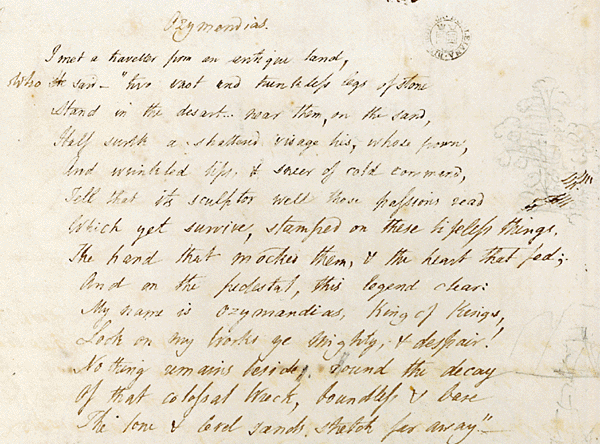
- The image above comes by way of the National Library of Australia.
What’s interesting to me is that you get to see Shelley’s original punctuation without the alteration of a modern editor. What’s most interesting is that there is a comma between them and and.
The hand that mocked them, and the heart that fed;
This, perhaps, makes it more likely that “heart that fed” refers to Ozymandias rather than the artist; but is not so conclusive as to omit other interpretations. Again, read it how you will. Below is the poem the way Shelley wrote and punctuated it. The differences from the Oxford edition are in red.
I met a traveller from an antique land,
Who He said – “Two vast and trunkless legs of stone
Stand in the desert. . . Near them, on the sand,
Half sunk a shattered visage lies, whose frown,
And wrinkled lip, & sneer of cold command,
Tell that its sculptor well those passions read
Which yet survive, stamped on these lifeless things,
The hand that mocked them, & the heart that fed;
And on the pedestal, this legend clear:
My name is Ozymandias, King of Kings,
 Look on my works, ye Mighty, and despair!
Nothing beside remains. Round the decay
Of that colossal wreck, boundless & bare
The lone and level sands stretch far away.“
- If you want to read a brief discussion of the Bodleian Ozymandias Draft, go here.
On the other hand, the copy below, which is presumably a later copy, comes from The Poetical Works of Percy Byssche Shelley: Given from his own edition and other authentic sources. The editor, Harry Buxton Forman, gives us Shelley’s poetry straight from the manuscript (or so he leads us to believe). His copy of Ozymandias is similar to the Oxford edition:
I met a traveller from an antique land
Who said: Two vast and trunkless legs of stone
Stand in the desart. Near them, on the sand,
Half sunk, a shattered visage lies, whose frown,
And wrinkled lip, and sneer of cold command,
Tell that its sculptor well those passions read
Which yet survive, stamped on these lifeless things,
The hand that mocked them and the heart that fed: [8]
And on the pedestal these words appear:
“My name is Ozymandias, king of kings:
Look on my works, ye Mighty, and despair!”
Nothing beside remains. Round the decay
Of that colossal wreck, boundless and bare
The lone and level sands stretch far away.
Notice the missing comma in line 8. While I can’t find a manuscript image anywhere on the web, what this tells me is that another (and later) manuscript version must omit the comma in the eighth line. I’m guessing that the omitted comma represents Shelley’s  final thoughts and that modern editions (that include the comma) represent editorial interpolations. So, where does that leave us? Shelley must have had second thoughts about the line’s punctuation (as well as other lines). Whether he saw that change as altering the meaning of the line remains conjecture. If I learn more, I’ll add it to the post.
- The poet Marie Marshall offers readers another way to interpret Shelley’s great poem. Definitely worth reading.
By Way of Comparison
By way of comparison, here is Horace Smith’s Sonnet. Rather than just post it, let’s take a look at it and see how it differs. Such examples are rare, but they can teach poets a tremendous amount about the difference between competent poetry and great poetry.
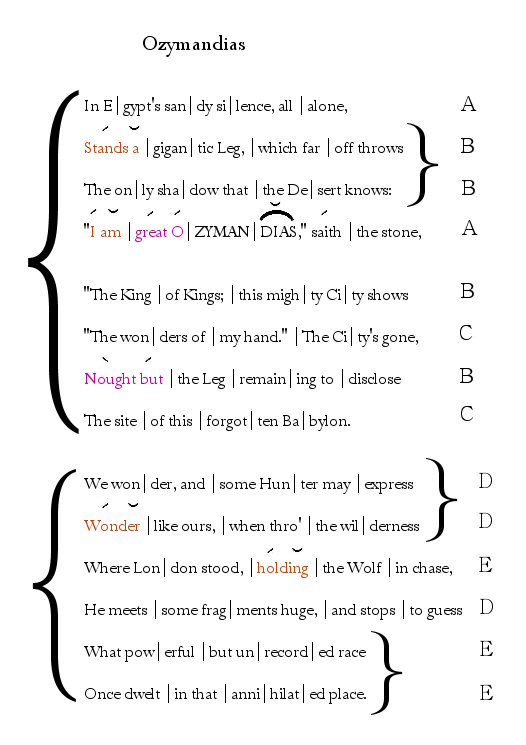
The rhyme scheme is different.
Simply in terms of hewing to a form, Smith does a better job than Shelley. But that’s as far as it goes. The words that Smith emphasizes through trochaic variation seem at odds with each other and even arbitrary. Emphasizing the word wonder, for example, undercuts the underlying message of devastation and “annihilation”. Not only that, but by this time the word wonder has made its third appearance! Admittedly, wonder had a somewhat different meaning in Smith’s day, but not that different. The emphasis on wonder through amateurish and unimaginative repetition subliminally contradicts Smith’s stated goal – an expression “annihilation” and loss. Possibly without knowing why, the reader is left with a sense of wonder – but also uneasy contradiction.
The trochaic holding is a wasted variant foot. There is no compelling reason to emphasize holding.
Notice also Smith’s personification of the desert in the second line: The only shadow that the desert knows… In effect, Smith is superfluously introducing a second character – the desert. The only reason he has done so is for the sake of the rhyme throws/knows. The effect is to divert the reader’s attention from the central character, Ozymandias’ ruined city. Likewise, when Smith writes, saith the stone, he is unwittingly giving life to desolation: the desert knows, the stone saith…
These unwitting mistakes are the hallmark of a lesser talent. Where Shelley carefully focuses the reader’s attention, avoiding superfluous information (which includes personification), Smith doesn’t. His mention of Babylon, already rich with associations, further dilutes the centrality of Ozymandias’ ruins. In comparing Ozymandias’ ruined city to Babylon, Smith is as much as implies that Babylon, not Ozymandias’ city, is the standard for comparison. Shelley doesn’t make this mistake. In Shelley’s sonnet, Ozymandias’ ruins stand alone and incomparable.
The final sestet changes our locale entirely.
Smith imagines a hunter in the ruins of London. Smith spells it out. The ruins of Ozymandias stand as a kind of metaphor for what could happen to London and its “unrecorded race”. Where Shelly leaves it to the reader, Smith spells it out. Where Shelley’s sonnet gives a feeling of immediacy and co-discovery, Smith’s sonnet has the feeling of a sermon. Smith tells us what to think. Shelley lets us discover it for ourselves.
If you enjoyed this post or found it helpful, please comment!
~ November 17 2014
- Just having posted this, thought I’d add it here too. No one elsewhere has noticed or mentioned the echoes of Ozymandias. Anyway, I’m a little late to the competition but add my effort to Horace Smith’s.
Here lies the preacher Zebediah Grey:
A pillar, incorruptible, severe;
Who suffered not the children at their play
Nor tidings but humility and fear.
“Tempt not,” said he, “the wrath of righteous love—
The love that strips the unrepentant bare.
Lure not that retribution from above;
 Look on God’s works, ye blithesome, and despair:
How fleeting be your joys, how little worth!”
The congregation trembled at his scowl
And with him daily praised this hell on earth;
But friend if only you could see him now
····Whose sneering adumbrated mankind’s sins—
····If only you could see him— How he grins!
Zebediah
November 16 2014 • by me, Patrick Gillespie
 PoemShape
Patrick, I did enjoy this post. Its an excellent piece of analysis on a fascinating poem. Examining the meaning of the poem through the scansion is useful.
Nield’s comments are a good inclusion, as is the comparison with Smith’s sonnet.
You have distracted me from my own writing again… damn you.
LikeLike
As always, your in depth analyses inform and help me understand these works on a deep level.
LikeLike
Thanks Kevin,
Your comments cheer my up. I’ve been a little blue lately.
LikeLike
Another wonderful post. I swear, these are better than anything I have to listen to at school – not only are they more concise, but more insightful than the typical professor’s spiel.
LikeLiked by 1 person
Thank you again Jackie.
I’d love to be a professor… giving spiels on poetry. Sigh…
LikeLike
I’m sure you could get into an MA or a Phd program if you applied… the professors here at Berkeley say that it is generally a very pure application process and they care mostly about your grades, GRE scores, and writing sample, but not really what you have been doing with your time or how long you have been out of college.
Then again, you might not be ready or able to spend time doing that much schooling? I know most community colleges hire people with Master’s degrees, which only take two years.
But I am sure you know all this! I only thought to say something about it because it seems to me like you could easily do it if you had the time for it.
LikeLike
With regard to the 8th line of Shelley’s “Ozymandias”, I would interpret it as:
“The hand (the sculptor’s) that mocked them and the heart (Ozymandias’s) that fed”
That is, the passions have survived both the sculptor and Ozymandias. Cruelty and tyranny were still present in Shelley’s day (as they are today).
This interpretation points towards the continual struggle of love and compassion against cruelty and tyranny, of enlightenment against ‘self as centre of the universe’.
LikeLiked by 1 person
Thanks, Ralph, for your comment! I think your interpretation is possible & a valuable perspective. I also think the idea of a “continual struggle” is inherent in both our interpretations. But Shelley doesn’t give us much to go on. On purely thematic grounds, the reason I opted to treat “the heart” as a reference to the artist is because all of Shelley’s other references to Ozymandias are in terms of ruins. A reference to Ozymandias’ heart would, to me, undercut this.
But, let’s take a look at the sentence without the aside:
I think that part of the confusion in these lines is due to shifting usage and meaning of words between the 21rst century and the 19th century.
The word mock has, in its older sense, the meaning of mimic [Shakespeare Lexicon p. 732]. This meaning survives in modern times in the more neutral “mock up”. A “mock up” doesn’t carry the sense of derision or contempt associated with mock. So… Ozymandias’ passions survive in the artist’s “mock up”. This isn’t to say that Shelley wasn’t aware of the words double meaning. More importantly, the word “fed” or “feed” also had the meaning: “to entertain or indulge” [Shakespeare Lexicon, p. 409]. So, in this sense, the artist’s heart was entertaining and indulging Ozymandias’ cruel passions.
I think its hard, without any indication from Shelley, without a grammatical cue (through punctuation or otherwise), to assert that the hand is the artist’s and that the heart is Ozymandias’s. The conjunction and argues that both the hand and heart belong to the same agent.
Lastly, your interpretation would undercut the possible interpretation that art, and all that it represents, was the totality of what remained to Ozymandias’ “empire”. Though admittedly your interpretation is aiming for a different conclusion – one in which neither compassion nor cruelty are triumphant. That’s possible, even though Shelley makes it clear that nothing has survived Ozymandias’ reign but the work of the artist. In your favor, even if it doesn’t support your reading of “the heart”, is the irony that the artist has, at the same time, preserved Ozymandias’ “cruel passions’ — that is, Ozymandias’ cruel passions “yet survive” on those “lifeless things”.
LikeLiked by 1 person
I understand it differently. The way I read the line, the passions are the object. The hand of the sculpter mock’d the passions of Ozymandias while the heart of Ozzymandias fed them.
LikeLike
I would take the interpretation as being the ‘hand (of the sculptor) that mocked’ (mimicked and/or made fun of) the ‘passions’ that are visible on the statue’s face (the arrogance and ‘sneer of cold command’), and the ‘heart (of Ozymandias) that fed’ those passions – the cruelty of Ozymandias’ heart that were ‘stamped’ into his face.
Whether the real Ozymandias had a face that betrayed his cold-hearted arrogance, or whether the sculptor chose to represent him in this way, is a matter for debate, of course.
However, I think this holds water when you remove the subordinate clause:
‘those passions that yet survive the hand that mocked them and the heart that fed’ – the cold command and sneer of those in power have survived, ‘stamped in these lifeless things’, beyond the life of both the sculptor who created the statue and the life of the sculptor’s subject, whose features were so vividly captured.
LikeLike
I’ve come to think that interpreting this line is like a Rorschach test. How you choose to read it will inform the meaning of the sonnet as a whole, and probably reveal more about us, as readers, than the poem itself. :)
LikeLiked by 1 person
I was so glad to read your interpretation of this poem. My son has to memorize it for his humanities class (7th grade) and I had many questions about the middle part. I was very confused by “the hand that mocked them and the heart that fed” I like your interpretatoin of it being about the sculptor/artist. Another interesting fact that I read elsewhere, is that there is a double irony here, since Ramses II is one of the most famous of the Egyptian pharoahs (he was Pharoah in the time of Moses) and according to the other post many of his works still stand today. (Pyramids maybe?) So is this a double irony? If you read the poem without knowing it’s about Ramses (as I first did) you assume whoever Ozymandias is is lost and gone thus giving the words on the pedestal their ironic meaning, and also you could read into it regarding every man’s eventual demise, etc. However, knowing it is about Ramses changes it, since obviously there is much that still remains of him and knowledge of him will last as long as there is written history. Of course the artistic treasures will last as long too!
LikeLike
Hi Deborah, I’m glad the post was helpful.
If I were the betting kind, I would bet against this interpretation. It’s somewhat anachronistic. The interpretation relies on the notion that Shelley would have known the history of Ramses II and the monumental building works inspired by him. However, Shelley wrote Ozymandias in 1817 and died in 1822. Hieroglyphs weren’t deciphered until 1822. As the following site points out:
You write:
And I think this is how Shelley wrote it. He wouldn’t and could not have known what we now know about Ramses II. What’s the other post you are referring to? I’ m just curious Others might enjoy reading it.
LikeLiked by 1 person
I greatly enjoyed this essay. No great fan of Shelley in general, I continue to find the second quatrain to sound stilted; its meaning, moreover, remains much too obscure for my taste. Nonetheless, I consider this sonnet’s sestet among the truly noble–and I pick that adjective partly for its irony–lines of English poetry. The dramatic contrast between lines 11 and 12 is an amazing and even profound achievement; note how even Gray’s great line expressing a similar thought pales by comparison: “The paths of glory lead but to the grave.”
If some of us are prone to take poetry too seriously, here is a six-line caution against erring in the opposite direction!
LikeLiked by 1 person
Neither am I. I keep expecting him to turn into a Keats or Shakespeare, but he never does. One gets the impression that he wrote too easily and quickly. His adjectives are frequently too pat, too many metrical fillers, too many repetitive verbs, adverbs and nouns, too many expostulations. He’s like the Vivaldi of poets – one sequence after another. I keep wanting to like him more, but I lose patience with him.
On the other hand, he wrote a small handful of indisputably great poems.
LikeLiked by 1 person
Well said. He perhaps was less disciplined, as a person and a poet alike, than the very greatest?
LikeLike
You know, it’s one of those questions that gets to the heart of genius. The way you frame the question, it implies that Shelley didn’t live up to his true potential. But maybe he did?
It fascinates me how so many artists, composers, poets and writers can be so utterly blind to their own limitations. There’s a book called The Joy of Bad Verse, and what fascinates me is how such completely inept and mediocre poets can be so convinced of their own genius – so blind to their own artistic limitations. William McGonagall is a case in point. Of this poet, Stephen Pile wrote: “He was so giftedly bad that he backed unwittingly into genius.” Yet McGonagall was convinced he was the heir to Shakespeare and Burns – even to his dying day he was convinced.
A modern counterpart to McGonagall is Dan Schneider. Here’s a man that is neither great nor giftedly bad – but a true poetaster and mediocre poet. And yet he is undissuadably convinced of his own towering genius. He is absolutely blind to the failings of his own poetry even as he touts the limitations of others. Men like McGonagall and Schneider fascinate me. Apparently, there’s more to genius than creative faculty. (Music, art and literature is littered with tremendously prolific mediocrity.)
It seems there has to be an almost transcendent ability to appraise ones own work.
I think Shelley was writing what he considered to be works of genius (and sometimes he did). He clearly thought (and all but said) that his own poetry was superior to Keats. However, he finally seemed to lack that last component of genius which is the ability to recognize and synthesize what’s best in a diverse range of aesthetic considerations (and to hold is own poetry to that standard).
Just thinking aloud…
LikeLiked by 1 person
I suppose there have been millions of great geniuses ITHO (in their humble opinions) for every one generally acknowledged as such!
One more “Ozymandias” remark: the lateness of the volta adds to its dramatic impact, I think; an ancient arrogant boast lost in the middle of nowhere is a powerful juxtaposition of images that makes its own point. The volta here therefore is not, as it is in so many fine sonnets, a turning point in an argument. Indeed, with “Nothing beside remains,” the argument, such as it is, is already over.
LikeLiked by 1 person
I thoroughly enjoyed this analysis and information.
LikeLike
Thanks for the comment, Mary. :-)
LikeLike
What do you think of the interpretation that the word “survive” should be used as a transitive verb? The meaning would then be that only the passions captured on the visage remain. They “survive” or outlive both the sculptor (the hand that mocked or crafted the passions on the visage) and Ozymandias (the heart the fed the passions on the visage.) In other words, the passions are the only thing that remains while Ozymandias himself, the sculptor, the kingdom, etc. have all decayed. So here may be the irony: the passions are truly empty of merit since there is nothing left to be passionate about.
LikeLike
Whoa… sorry it took me so long to approve this. Thought it was already approved.
That’s a cool take. I like it. Not only did the passions survive, but they killed the things that fed them. That is, the statues, the kingdom, and the cities which were the product of Ozymandias’ passions, were the very things his passions survived by destroying.
LikeLike
Thank you for your great analysis of this piece. I completely agreed with your assertion that people tend to gloss over line 8 because it is difficult. I have to say though that Reading the poem again after your comments I feel that I am with Ralph the ‘hand’ is that of the artist the ‘heart’ belongs to Ozymandias. The inclusion of the ‘and’ does not preclude this as the line might read ‘the passions which the artists showed and the tyrant’s heart generated’. This doesn’t detract from your feeling that it is only art that remains because the line before says that passions survive stamped on what the artist created.
Thank you for your work
LikeLike
I keep trying to read it and see it the other way around (like a Ror-Shak test). Lay the sentence out like this (omitting the clauses and metrical padding):
Once you’ve taken out all the dependent clauses, the whole of it begins to sound more like modern English (Shelley had a rhyme-scheme to keep). But, anyway, this is the heart of the sentence.
So… if you read “heart” as being Ozymandias’s, you would read it this way:
In other words, the despot’s passions survive (outlive) the heart that fed them (the passions). [EDIT And to make matters more confusing, you could also read this in the sense of the artist’s heart having “indulged or entertained” them (the tyrant’s passions) – if the word fed is understood in its older meaning (see above)]. Another way to read it, if you read heart as belonging to the artist, is to read the sentence this way:
The pronoun it would refer to the hand of the artist. Unfortunately (or perhaps fortunately) Shelley never wrote the pronoun, so it could be read either way. It all depends on how you want to interpret the poem. :-)
LikeLike
I wanted to weigh in on the hands/heart issue. I side with the sculptor/hands, ozymandias/heart interpretation. However, building off your last post, I might suggest that while the scupltor’s hands made the image, Ozy’s [cruel] heart fed the sculptor’s hands—something which could be further illustrated by the fact that the phyrric foot falls between “The hand that mocked” and “the heart that fed”, structurally reinforcing the separation. Thematically, this would suggest that “those passions” which survive are those which relate the subtext of the artist and the tyrant. In the context of the ruin this suggests that the “read” on line 6 refers not to the realism of his sculpting, but to the prescience of the artist, who knows that time will ultimately undo the work of the king (the message which Shelley has received.) Ruins are aesthetically completed by their natural undoing. As Simmel wrote: “The aesthetic value of the ruin combines the disharmony, the eternal becoming of the soul struggling against itself, with the satisfaction of form, the firm limitedness, of the work of art…This purpose and accident, nature and spirit, past and present here resolve the tension of their contrasts—or, rather, preserving this tension, they yet lead to a unity of external image and internal effect.”
[Georg Simmel, “The Ruin,” in Georg Simmel, 1858-1918, trans. Kurt H. Wolff (Columbus, Ohio State University Press, 1959), 265-6.]
Perhaps I’m reaching a bit, I was just mulling these things over when I came to your fantastic post and wanted to get your input.
I was wondering if you might also comment on the placement of the colon at the end of the 8th line. In the interpretation that I’ve offered, it almost seems to necessitate a colon in the 7th line, something like:
Tell that its sculptor well those passions read
Which yet survive, stamped on these lifeless things:
The hand that mocked them and the heart that fed
The current construction is a bit strange to me—I understand the colon at the end of the 9th line, but the colon at the end of the 8th is a bit strange. I’m admittedly a bit out of my element, just wanted to get your input. Again, great post and discussion—hope you have a chance to dive in a bit more.
LikeLike
Hi Brian, sorry that I was out; but welcome!
This poem has gotten more attention than any of the other poems I’ve talked about. I think it’s all because of this one line.
I would hesitate to support your interpretation with the phyrric foot. For me, this veers too close to an Enactment Fallacy. There’s no way to know whether this is how Shelley intended the phyrric foot (And I don’t think there’s any support for it elsewhere in his poetry). Fortunately, I don’t think you need that rationale to support your interpretation.
It’s certainly possible (in accordance with your interpretation) that what Shelley meant was as follows:
The sculptor well those passions read/ which yet survive/ The hand that mocked [both] them and the heart that fed [the passions]…
This makes perfect sense and anyone is well within their right to read it this way. The alternative would be as follows:
The sculptor well those passions read/ which yet survive/ [Both] the hand the mocked them and the heart that fed [indulged those passions]…
The alternative plays on the older sense of fed or feed. Is it possible that Shelley was playing on both meanings? If it were Shakespeare, I wouldn’t blink; but Shelley isn’t known for his wordplay.
I wouldn’t disagree with this at all, regardless of how one interprets Line 8.
The use of punctuation has never been static. I think Shelley was using the colon where, in modern practice, we would use a semi-colon. That is, the modern usage of a semi-colon can be to join main clauses both joined, and not joined, by a coordinating conjunction. (This is giving Shelley the benefit of the doubt.) As to placing a colon after line 7, that turns the hand and the heart into “those passions” the artist has “stamped” on the sculpture. In other words, the hand and heart become appositives. They would define or explain what the “lifeless things” are: “lifeless things such as the hand that mocked and the heart that fed”. A colon is used to introduce summaries, explanations and series (Little Brown). You would also want to get rid of the comma. Unfortunately, the end result of all this doesn’t make much sense.
Anyway, both interpretations are viable. It does makes sense (as you and others assert) that the passions outlived the heart that fed [them] because of the artist’s hand – the hand that mocked them.
It also makes sense to read it as follows:
Which interpretation you pick depends, in part, on how much importance you give to the word heart. Does it make sense, when all else is desolation and ruin, for Shelley to refer to the Tyrant’s heart? Or does it make more sense that Shelley refers to the artist’s heart? My own feeling is that it makes more sense that the heart (with all that it symbolizes) refers to the artist, not Ozymandias. That’s not to say that I’m right, but this is the reason I lean toward one interpretation more than the other.
LikeLike
This was the first poem that affected me profoundly in eight grade. I have since spent many years loving, reading, thinking about and translating poetry. Someone asked me about this line yesterday and it occurred me that “the hand that mocked” is the sculptor and rhetorically it would make sense to juxtapose that with the “heart that fed” the hand of the sculptor with those emotions. I thought I would see what others thought, and found your wonderful website. I enjoyed your take, which is certainly valid as he is ambiguous and elliptical. Keep up the wonderful work.
LikeLike
Hi Hamza, nice to read your comment. At this point, I think that Shelley’s line must be one of the most ambiguous in all of literature! It’s like a self-referential equation.
LikeLiked by 1 person
I appreciated your essay and the comments. But I believe Smith’s poem is almost as great as Shelley’s. A good poem can be a time machine. Shelley takes us into the far past and returns us to the present. Smith takes us into the far past and then to the far future.
LikeLike
I, personally, would be hard pressed to argue for their equivalence. The preponderance of critical opinion leans in Shelley’s favor (not that the preponderance is always correct). If, for you, they are equally enjoyable, then who am I to gainsay?
LikeLike
Pingback: Not to get all philosophical about S.W. Erdnase . . . | S.W. Erdnase: 20 Years Later
I came across your commentary on this favorite poem while looking up a few lines to quote in a blog post about the effects of time on buildings. Your analysis is so cogent, and though for me the jury is still out on that most u “hand / heart” line, you made me think afresh about the poem after having been familiar with it for so long. Ambiguity keeps things interesting, after all, and maybe that’s why Smith’s Ozymandias seemed inferior to me, almost humorously lacking the power of Shelley’s work.
LikeLike
Thanks Caroline! I’d love to be able to explain what that line means, but not only is the jury out, the statute of limitations kicked in. I agree that Smith’s Ozymandias isn’t as good, but some readers (very few I think) prefer it.
LikeLike
Having just written up an entry on “Ozymandias” for my web-log, I figured I’d take a look here, figuring you’d have had your say, and, lo, you have––and a very fine say it is. Thanks.
LikeLike
The cold, arrogant passions still survive, stamped into stone by a greatly sensitive, heart-fed talent, whose own head would have rolled to the sand had s/he had not produced a visage which pleased Ozymandias’s. Power can command art to tell Power’s story. Time destroys power and art.
Submitted on 2011/10/27 at 2:45 am
Please make that . . . whose own head would have rolled to the sand had s/he not produced a visage which pleased Ozymandias. Would the sculptor have dared to carve a slight hint of ridicule into the stone? No! Not worth it. Just do the job and go home to loved ones.
Submitted on 2011/10/27 at 2:52 am
Yes, the sculptor would have liked to have placed a hint of mockery or ridicule into the visage. The sculptor had the heart, eye and hand to make it so, but did not dare. And so, the cold passions survive even that artist’s desire.
LikeLike
Hi Conner, I put all your comments together. Your first comment assumes that Ozymandias was smart enough to read the artist’s intentions. He might have been, and he might not have been. Shelley doesn’t tell us. I tend to think that the artist was smarter than the tyrant. (Artists, historically, are always smarter than politicians – unless the politicians are themselves artists.) :-)
So, the artist might have given Ozymandias exactly what he wanted – “pleasing” the tyrant while letting the world know exactly what kind of man the artist was dealing with.
I’m also not sure I would call what the artist did ridicule. Tyrants usually have a good nose for ridicule. Tyrants, however, have a very poor nose for their own pomposity and grandeur. I can easily imagine a good artist capturing the cold sneer and arrogance of a tyrant – that being precisely what the tyrant most admires about himself. Such statues are everywhere and being made right up to today.
LikeLike
Please make that . . . whose own head would have rolled to the sand had s/he not produced a visage which pleased Ozymandias. Would the sculptor have dared to carve a slight hint of ridicule into the stone? No! Not worth it. Just do the job and go home to loved ones.
LikeLike
Yes, the sculptor would have liked to have placed a hint of mockery or ridicule into the visage. The sculptor had the heart, eye and hand to make it so, but did not dare. And so, the cold passions survive even that artist’s desire.
LikeLike
Pingback: Some Notes on “Ozymandias” « The Era of Casual Fridays
For me the beginning of the poem is just setting, well written setting, but getting into the “heart” and “hand” is IMHO missing the point. All the real interest and comment of the poem plays out in the double meaning of the inscription.
The juxtaposition of the superficial despair the mighty feel when looking on his works (such as this very statue). And the more true despair the mighty find when they contemplate the emptiness that surrounds the statue.
It is a simple point, but one that cannot be repeated often enough. You cannot take it with you. In fact you cannot even leave it behind. Everything you were, are or will be, will one day be dust, forgotten.
It has a stronger kind of resonance as well given the setting the poem was written in…one of the most powerful empires the world has ever seen. In some ways the poem could be seen as a message to Britain’s ruling class directly, a shot across the bow for those who had lost touch with the impermanence of man’s impact, even among the most impactful of men.
LikeLike
Thanks Joshua, all good points.
Although, should you declaim this poem to Britian’s ruling class, they might gently point out to you that Shelley’s poem immortalized Ozymandias and his statues are displayed in museums throughout the world. :-)
LikeLike
Loved your commentary by the way. I see now that got lost in my initial comment.
LikeLike
P.B. Shelley sux.
I have to study it in class. Its so freaking tough. Who speaks like that anyway?
LikeLike
Yeah, that’s the way I felt about quadratic formulas. Who needs them anyway?
Guess it’s whatever floats your boat. If you never read another poem for the rest of your life, you won’t be the first. You know, and to be honest, a lot of these poems were a complete mystery to me when I was in high school.
LikeLike
To do justice to quadratic formulas, you do need them. A lot. To do justice to Shelley, it would be very hard to invoke the same sense of irony(without the juxtaposition of the terrible grandeur of the words written on the statue and it’s isolation) without the form that he has used. Also, the pleasure lies in the interpretation.
LikeLike
//To do justice to quadratic formulas, you do need them. //
It’s possible that my software, in one form or another makes use of quadratic formulas but, beyond that, I have never, in my entire life, made use of or needed the quadratic formula to solve a given problem – trigonometry, yes, but never the quadratic formula. :-) Just saying.
LikeLike
Thanks a lot.We have this poem in our school text book and your study on this poem helped me to understand this in a abetter way.
LikeLike
Thanks Jetfire. :-) I do my best.
LikeLike
I like the interpretation that attributes the hand to the artist and the heart to Ozymandias in the sense that the heart is feeding, or indulging, the artistic hand. It is giving the hand passions to mock, in other words.
LikeLike
Thanks Kory, I don’t think there’s anything wrong with that interpretation. Maybe something will show up someday that reveals what Shelley, himself, was thinking. Or maybe it doesn’t matter. :-) The fun is in interpreting it.
LikeLike
Thank you for your commentary and all the posts and responses. This is an intelligent discussion and very useful to share with my class of high school students. I love that they can read this discussion and delight, I hope, in the ambiguity … indeed, have fun in interpreting it (or trying to!)
LikeLike
Hey Martha, that’s really a wonderful thing to say. I think of all the poems I’ve talked about, Ozymandias has gotten the most discussion just because of the ambiguity.
LikeLike
Your analysis of this poem is the best I’ve come by so far, and it really helped me with my assignment because I couldn’t understand anything in the beginning. I do now!
However, I am still confused with the line, “The hand that mocked them and the heart that fed”.
Even after reading your analysis of it (which is good in every sense), I can’t link it with the preceding or the following line, so I don’t understand it!
Would you mind clarifying that for me please? :)
Thanks and great work!
LikeLike
//Even after reading your analysis of it (which is good in every sense), I can’t link it with the preceding or the following line, so I don’t understand it!//
OK. I assume you’ve read all the comments because there’s much good help in them. Here are the lines:
The trouble is that there are, really, two entirely different ways to read these lines (I’ve given other possibilities above, but this is where I’m leaning now):
1.) The frown and wrinkled lip of the shattered visage tell that it’s sculptor read those yet surviving passions well — [by “read” meaning] the [artist’s] hand that mocked them and the [artist’s] heart that fed [indulged the tyrant’s ego with his artistry/heart] (remember that fed also had the meaning of indulge).
2.) The frown and wrinkled lip of the shattered visage tell that it’s sculptor read those yet surviving passions well — [those passions in the form of] the [the tyrant’s] hand that mocked them and the [tyrant’s] heart that fed [on their abasement and is expressed on the visage and “the hand”].
Again, the problem I have with the second interpretation, which is favored by many, is that it defeats Shelley’s point, to a certain extent. We are led to believe that the only things which survive are the frown and wrinkled lip. If readers interpret the line in the second manner, then not just the “visage” survives but also, somewhere, the tyrant’s hand and proverbial “heart”. In other words, the artist stamped on all those lifeless things — the tyrant’s face, the hand and the proverbial heart — those yet surviving passions. More than just the frown and wrinkled lip survive, which somewhat mitigates the starkness of the image.
However, I nevertheless think there’s room for the second interpretation. You will have to decide which you prefer. :-)
LikeLike
Thank you! I’ll try to form my own analysis as well, but I think I understand it better now!
LikeLike
I was a confused student, trying to figure out what the poem meant, until I read your post.Thanks, this is really helpful
LikeLike
I really do think that this is a valuable anylasis. Acc to me in the 8th line the Hand and the Heart are both of ozymandias. Observe that ozymandias being a proud and haughty king might have made fun of his people, although on the other side he might have fed them because after all it was his kingdom and his people. Maybe itz like this…
LikeLike
Thanks a lot!! Amazing Post
LikeLike
You’re welcome. :-)
LikeLike
Hi I just want to say that you are doing a fantastic job interpreting this poem. I’m still having trouble with the 6th and 7th line though namely “Tell that its sculptor well those passions read which yet survive….”
What does it mean by which yet survive?
LikeLike
Hi Carter. Another reader at my guestbook commented on this. (I also commented on it in the post but it’s fairly dense so you may have missed it). Anyway, he put it best, so I’ll just copy what he wrote:
You can find his original comment here. Look for Thaddeus Joseph Stone.
LikeLike
Ah I see. So would you say that the poem expresses that death is not as hopeless since something can still survive after so long?
LikeLike
:-) You’re asking the wrong question.
There are some things which we ‘hope’ will die – like tyranny, cruelty, arrogance, etc… In this case, “those passions” (those cruelties of Ozymandias) could be construed as “yet surviving” both in the art of the artist and in us – the latter being unfortunate.
LikeLike
So in conclusion, even if the person and their works may die there will always be others to inherit their beliefs? Is the poem trying to express this in a positive or negative way?
LikeLike
So… in conclusion? You’re not trying to write a paper, are you?
But no, this isn’t the core message of the poem, but one aspect of an interpretation which is, itself, just one among a number of possible interpretations. Do you think Shelley would portray the “yet surviving” passion of tyranny (if that is how you interpret it) in a positive way?
LikeLike
Ah I see then. No I’m not writing an essay but I’m just curious about this poem because the section about the sculptor always confused me since I always thought this poem was about the inevitability of death. Now I see that there’s more to it. Thank you!
LikeLike
Regarding line 8 (which puzzled me), and line 9:
“The hand that mocked them, & the heart that fed;
And on the pedestal, this legend clear:”
The double meaning of “mock” (replicate, vs deride) helps me to read the poem as it may have been originally intended. The sculptor replicated the king’s visage, while subversively deriding it at the same time (So also Michaelangelo vis-a-vis his patrons, as he completed the frescoes in the Cistine Chapel).
And, taking “fed” in the sense “to feed one’s passion,” it was the sculptor who “fed” (indulged) the king’s grandiosity. This brings me to line 9: It seems to me there is a missing subject and verb (omitted for the sake of poetic form), that bolster the preceding interpretation of line 8:
“And on the pedestal, the sculptor carved this legend clear:”
If one imputes this meaning to line 9, the lines 8 and 9 together make much more sense to me.
Sorry if someone else may have come to the same conclusion. I did not read through all 64 preceding comments.
LikeLike
Thanks Jim. Yes, that’s the way I read it too, though I didn’t think to put as much weight in this observation.
Who else would have inscribed that but the artist? I suppose one might question who’s words the inscription represents – the artist’s or the tyrant’s. But I’m also not sure that it matters. If it was the artist’s inscription then, like the rest of his work, there’s a layer of irony (though the artist could never have inscribed the work without Ozymandias’s approval). If the inscription was prompted by the tyrant, then there’s also that same irony.
I prefer thinking that it was the artist’s work, since it’s in keeping with the theme of the artist “mocking” Ozymandias (in every sense) right under the ruler’s nose. I like that.
LikeLike
Hi, the effort invovled in producing this site is greatly appreciated, thank you.
I will be sure to read more of your infromative, interesting and insightful posts, keep them coming.
LikeLike
Thanks Mamoon, I’m working on a novel right now, but hopefully more posts will come in the future. :-)
LikeLike
Thank you :)
LikeLike
I came across your site looking for an answer to another question regarding Smith and Shelley, but was pleasently surprised by what I found here even though it didn’t answer my question. Thank you so much!
I think that you-all are making line 8 too difficult. The subject at this point is the look on the face of the statue; the hand refers to the sculptor’s hand that caught the ‘frown, wrinkled lip and sneer of cold command”; the heart that fed is the heart of the Ozmandias for – as Jesus pointed out – the evil that men do comes from within, from the heart, and is often recored in their faces as Shelley is pointing out to us.
Do you remember the story by Oscar Wilde “The picture of Dorian Gray”?
The novel tells of a young man named Dorian Gray, the subject of a painting by artist Basil Hallward. Basil is impressed by Dorian’s beauty and becomes infatuated with him, believing his beauty is responsible for a new mode in his art. Dorian meets Lord Henry Wotton, a friend of Basil’s, and becomes enthralled by Lord Henry’s world view. Espousing a new hedonism, Lord Henry suggests the only things worth pursuing in life are beauty and fulfillment of the senses. Realizing that one day his beauty will fade, Dorian (whimsically) expresses a desire to sell his soul to ensure the portrait Basil has painted would age rather than he. Dorian’s wish is fulfilled, plunging him into debauched acts. The portrait serves as a reminder of the effect each act has upon his soul, with each sin displayed as a disfigurement of his form, or through a sign of aging in the figure in the portrait. When Dorian sees it he realized his wish has been fulfilled. Deciding that only full confession will absolve him, he decides to destroy the last vestige of his conscience. In a rage, he picks up the knife that killed Basil Hallward and plunges it into the painting. His servants wake hearing a cry from inside the locked room, and passers by on the street fetch the police. The servants find Dorian’s body, stabbed in the heart and suddenly aged, withered and horrible. It is only through the rings on his hand that the corpse can be identified. Beside him, however, the portrait has reverted to its original form.
Only Ozmandias’ portrait didn’t change.
Even so, the question that brought me here is: why does Smith refer to the statue with one leg while Shelley refers to “trunkless legs”? Do you have any info on this?
LikeLike
…why does Smith refer to the statue with one leg while Shelley refers to “trunkless legs”? Do you have any info on this?
I don’t, but I can speculate based on what we know. We know that neither Shelley nor Smith had seen the statues when they wrote the sonnets. From that, we can safely conclude one of two possibilities:
1.) They were both aware that the archaeological find was coming to the British museum. This was big news at the time. It’s very likely that descriptions of the find were accompanied by illustrations and that either or both poets could have been influenced by the illustrations (one could research what printed material they were likely to have seen). It’s possible that each poet was basing their poetry on different illustrations or descriptions.
2.) The second possibility is that both poets were writing a sonnet and that the form’s meter and rhyme demanded compromises. The point of the sonnets, after all, wasn’t to be historically accurate. In Shelley’s case, writing “One vast and trunkless leg of stone,” just doesn’t come off the same way. It almost sounds humorous. “Two vast and trunkless legs of stone” could have been based on an illustration or description and is correct, but also may simply reflect the exigencies of poetic license. In Smith’s case, the lines “In Egypt’s sandy silence, all alone/Stands a gigantic leg, which far off throws” work because Smith needed to rhyme with “knows” (in the next line). He could write “In Egypt’s sandy silence, all alone/Stand two gigantic legs, which far off throw“, but that would have thrown off the following lines. Nonetheless, he could have written:
But then Smith still has several other rhymes to correct. It snowballs. Much easier to put one leg in the desert.
Interestingly, there’s an 1817 draft of Shelley’s Ozymandias at the Bodleian Library in which Shelley initially writes, “
two trunkless legs of stone are crumbling [down]“, then scratches that out and writes, “the wreck of a colossal [form]“, then moves on, rethinks, goes back, scratches that out, and returns to “two trunkless legs of [brown]”. I’ve put the final words in brackets because I’m not positive I’m reading his writing correctly. So… what this suggests is that the idea of two legs was fixed in his mind from the get-go (so he was probably basing this on an illustration or description), but that he was just as content to substitute “colossal form” if he thought the description better suited the sonnet. In other words, it doesn’t sound as though the “leg count” was an essential facet of the poem.LikeLike
A very interesting post.
I cobbled together a few words on the poem myself, a while back:
M.
LikeLike
Thanks Marie, I linked to your post in my original Ozymandias post and commented at your site.
LikeLike
why did i enjoy this poem?
LikeLike
Wonderful site. Thanks so much for this; I found it very useful in my Eng3U class.
LikeLike
As much as I enjoyed your analysis and profited from your interpretation, I would gently and respectfully disagree with you regarding the line “the hand that mocked them, and the heart that fed.” I would agree that the sculptor is in view in the first half of the line; mocking the king throughout the long passage of time by stamping his interpretation of the monarch’s passions in stone. But in the last half of the line surely its is Ozymandias who is in view. It is the king’s heart that fed on those passions: the despotic rule, the contempt for common people. That is what makes the king such a vile creature. He loved.st He loved to rule; he loved to sneer at hose under him. His heart fed on such vile passions; he became fat in their excess. That I think is the poet’s intention here.
LikeLike
//But in the last half of the line surely its is Ozymandias who is in view.//
Thanks Anon. I wouldn’t agree that it “surely” refers to Ozymandias, but your interpretation is surely a possibility. The only route to greater certainty would be a revealing draft or a reference by Shelley.
LikeLike
Could you please help me; i need to write comparison between both H.S + P.B Shelley’s Ozymandias?
LikeLike
Sure, Katy, though I charge for my time. :-)
LikeLike
Hi! Great web site! I was struggling to understand line 8 ’til I found your analysis and all the great discussion. It’s awesome that you dig deep, speak plainly, and encourage alternate readings!
Having read your analysis and much of the discussion, and having re-read the poem many times, here is my current reading of the much-debated line:
… [the] frown, … lip, and sneer … tell that its sculptor well [read] those passions, which yet survive [i.e., outlive] the [sculptor’s] hand that mocked [those passions] and [Ozymandius’] heart [which] fed [those passions].
It’s possible that Shelley intended the double meaning of “mocked”, i.e., both “mimicked” and “ridiculed”. But my guess is that Shelley only intended the older meaning, viz “mimicked”. My reason is that, according to my current reading, the main point of this sentence is that the ruler’s passions (e.g., of cold military command) still survive today (and perhaps the reader should remain wary of such passions). Moreover, this point is well made by simply referring to the sculptor. That is, “the hand that mocked them” is (in my reading) simply a reference to “the sculptor”.
Bringing the concept of ridicule (mockery) into the reading seems (in my view) to obfuscate and dilute the main point of the sentence. The sculptor may, or may not, have tried to ridicule the ruler and/or his passions. (If he did, that fact pales in comparison to the fact that “nothing […] remains” of the ruler’s “works”.) In contrast, there is (in my interpretation) an important secondary point to be made, viz, that cold, military passions have survived. They have outlived the sculptor and his subject, and they live in some of leaders of today. This is (in my opinion) a point worth making!
Moving on to the question of whose heart, I’d say that, again, “the heart that fed [them]” is simply a reference to Ozymandius. The point being, again, that cold military passions have outlived Ozymandius; they exist to this day.
And by the way, the manuscript (from the National Library of Australia) has a semicolon after the word “fed”, and to me, a semicolon makes more sense. Why do all the modern versions have a colon? Where did that colon come from?
Many Thanks!
LikeLike
//My reason is that, according to my current reading, the main point of this sentence is that the ruler’s passions (e.g., of cold military command) still survive today//
I think that’s an excellent point and a valid way to interpret the line. That the cold autocratic cruelties of the tyrant continue to survive into our own day isn’t something I initially emphasized, but I think it’s implicit. As to mocked, there’s room for both interpretations so I, personally, would hesitate to guess at Shelley’s intentions (in the sense of excluding one meaning in favor of another).
//Bringing the concept of ridicule (mockery) into the reading seems (in my view) to obfuscate and dilute the main point of the sentence. The sculptor may, or may not, have tried to ridicule the ruler and/or his passions. (If he did, that fact pales in comparison to the fact that “nothing […] remains” of the ruler’s “works”.) In contrast, there is (in my interpretation) an important secondary point to be made, viz, that cold, military passions have survived. They have outlived the sculptor and his subject, and they live in some of leaders of today. This is (in my opinion) a point worth making!//
The counter-argument to this is the interpretation that the artist’s art triumphed over the passions of the ruler — art triumphed over power. This is very much in keeping with Shelley’s own political and philosophical beliefs. Reading the poem this way: The artist is the truth-teller and it’s the “truth of art” that has survived the ages, not the lies of Ozymandias’ vanity.
//Moving on to the question of whose heart, I’d say that, again, “the heart that fed [them]” is simply a reference to Ozymandius. The point being, again, that cold military passions have outlived Ozymandius; they exist to this day.//
And I think that’s the most common interpretation. I’m sure I’m in the minority believing that the heart refers to the artist, but I’m sticking with it. :-) I read the line as referring to the artist’s heart and his indulgence of the tyrant’s vanity. If I’m ever famous, no doubt some biographer will someday tout this interpretation as my one great failing.
//And by the way, the manuscript (from the National Library of Australia) has a semicolon after the word “fed”, and to me, a semicolon makes more sense. Why do all the modern versions have a colon? Where did that colon come from?//
It either comes from Shelley himself (as an edit), or his wife. When his wife published his works, she claims to have based them on his “authentic sources”. That’s the best we can do.
LikeLike
//The counter-argument to this is the interpretation that the artist’s art triumphed over the passions of the ruler — art triumphed over power. This is very much in keeping with Shelley’s own political and philosophical beliefs.//
Yes, that works too. And “Ozymandius” is the first thing I’ve read by Shelley, so I’ll take your word for it that “art triumphed over power” is one of his common themes.
//I’m sure I’m in the minority believing that the heart refers to the artist, but I’m sticking with it. :-)//
That’s certainly a valid interpretation. And it certainly reflects the genius of the poem, that different people interpret it (and enjoy it) in entirely different ways!
// //And by the way, the manuscript (from the National Library of Australia) has a semicolon after the word “fed”, and to me, a semicolon makes more sense. Why do all the modern versions have a colon? Where did that colon come from?//
It either comes from Shelley himself (as an edit), or his wife. When his wife published his works, she claims to have based them on his “authentic sources”. That’s the best we can do. //
SInce there’s some doubt, I’ll interpret it as a semicolon, for the time being. :)
Thanks for your response!
LikeLike
Just came across your discussion. Suddenly realised I’d never really taken the effort to ’understand’ line 8, while succumbing to its magic. Thanks to your analyses I have arrived at one conclusion and one fresh insight.
1. A conclusion.
First of all, thanks for linking ’survive’ to its objects … ’the hand’ and ’the heart’.
The fact that ’the HAND that MOCKED them’ and ’the HEART that FED’ make up such a striking contrastive pair convince me that the hand is the sculptor’s (that mimicked/ rendered the passions) and the heart is the king’s (the heart that fuelled/stoked (fed) the passions).
As to the particular passions themselves, while they certainly mirror those of today’s dictators, Shelley clearly states that they exist only as ’stamped’ on stone (= art). Much as architecture is ’frozen music’.
We might compare Keats’ slightly different (but equally Romantic) take on art, time and passion in ’brede of marble men’, ’the voice I hear this passing night’, etc.
2. A fresh insight.
It is not the poem’s ’how are the mighty fallen’ theme that primarily stains our brains. The prime poetical event of the poem (in sound Romantic tradition – ruminations among ruins, etc,) is a trip to a spot where once life and passions flourished (a puffed-up despot’s in this case) but where nothing now remains but some lifeless stone fragments. All is lost in ’death’s dateless night’. This is a visceral, not an intellectual or political, experience.
As an additional bonus, Shelley juxtaposes what is ’colossal’ (by human standards) to the vastness of the desert (long before Google Earth could zoom up and down, shrink or enlarge a city at will). This too helps park the the poem permanently in our minds.
LikeLike
Thanks!! I’ve been reciting this poem (to myself) for fifty years or so and just now understand line 8
(reading “survive” as transitive). It always bothered me that the hand and the heart were floating disembodied in the middle of the poem. No longer. Also reading “mock” as “mimic” makes good sense too.
LikeLike
Hi Anthony, I’m glad to hear that. I guess the most important thing the post does is to provide a forum where all of us can debate the line. It’s interesting though, how even as I was writing the post, I really couldn’t find a source that discussed it. I still lean toward my own interpretation, but the contributions of other readers (here in the comment section) have really opened my eyes to other possibilities.
LikeLike
thanx a lott for this analysis…. it helpd me a lott for my work..
and i agree with you about the HAND and HEART part… i know many of the people are taking it in different ways but i think this is th actual xplanation to it….
But again, its LITERATURE…. whose biggest characteristic is that it is not limited to facts, figures an possible xplanations…. every human mind is different and so thier interprtations and analysis of even a single line would also be different.. every min would read the poem with a diffrent meaning..
that’s how we get the varie and vast ocean of literature whose depth has yet not been discovered….!!
so we have to accept every possible explanation but go on with the one that we like or presume best…
LikeLike
Hi Arjyama, at least one other person reads it the way I do. :-) I also agree with you that the best literature gives itself over to many explanations.
LikeLike
Yes, “survive” is a transitive verb taking as its object the hand (of the sculptor, who “mocked,” or copied, the sneer and wrinkled lip, the expressions of Ozymandias’s passions), and Osymandias’s heart that supplied blood to, or fed, the passions and facial expressions. The poem seems perfectly clear, to me.
LikeLike
Thanks Richard, I think we’re all in agreement that the verb survive is transitive. The issue is who the hand and heart belong to. I can see it several (or primarily both) ways — and they are both perfectly clear. Interpreting the poem is like interpreting the “Rubin Vase”:
http://www.mpocares.com/news-events/mpo-visual-illusion/screen-shot-2012-05-02-at-10-30-21-am/
You cannot see both possibilities at the same time, but each possibility is perfectly clear.
LikeLike
This is a reply to UpInVermont’s reply to me. It’s more likely, I think, that Shelley’s intention is this: The heart is that of Ozymandias, the bragging tyrant. The verb “fed” refers to the passions and their representations in the sneer, etc. The sculptor’s heart, it seems to me, wouldn’t be characterized as feeding the passions. He’s depicting them. The “hand” seems clearly that of the sculptor, who has copied and (with the secondary implications of “mocked”) exaggerated the image of Ozymandias’s arrogance. I don’t think it makes sense to think of the sculptor’s heart as feeding, or the tyrant “mocking” his people or his audience. I’m trying to get at the writer’s intention, rather than using the poem.
LikeLike
Thanks Richard. Don’t forget that “fed” might have been used in a difference sense than we use it today.
As for getting at the poet’s intentions, there’s no way to do it but by “using the poem” (as you demonstrated in your comment). That is, unless a letter shows up in an old lady’s trunk in Austria (who, of course, wishes to remain anonymous) wherein Shelley explains exactly what he meant.
I think your interpretation is valid. It’s a good one, but it’s not the only valid one. The best that you can do is what you’ve done: make your case, give the reasons for it. I’m sure there will be readers who agree with you.
In truth, I don’t really have a dog in the hunt. I can see it both ways, though I do tend to lean toward my original interpretation — the hand and heart both belonging to the artist.
LikeLike
I’m glad to see that the issues raised in this post are still wide open.
At the heart of much literary debate is the weight given to readers’ interpretation (Roland Barthes ‘death of the author’) in the literary process. When an artist has completed a work of art he gives it to us, whether he likes it or not. It becomes ours, and we continue the process.
LikeLike
Frankly (and in my experience) most authors and poets prefer it that way. I know that Richard Wilbur has read my post on “Mind” and sagely said nothing (with a smile), neither confirming nor denying my interpretation (which I take to be the best sign of all). In my own case, I would never (and have not) gainsay a reader’s interpretation of my poems. Poet’s really enjoy seeing their works transformed and expanded through the imaginations of readers.
I would say that the only time I question the usefulness of interpretations is when critics and readers presume to speak for the poets and make the poets’ agenda their own. This is reflected in the truism that every critic of Shakespeare defines Shakespeare’s poetry and meaning in his own image. Helen Vendler really bugs me in this respect. She’s always presenting her opinions as though they were discovered fact, as though she were privy to the poets’ intentions. She might deny it, but that’s the way she writes (and she frequently gets the facts wrong).
LikeLike
But the whole point of a work of art being liberated from its originator is the freedom to interpret it wrongly, even to appropriate it…
Or if not the actual ‘point’ then at least an inevitable consequence.
LikeLike
//But the whole point of a work of art being liberated from its originator is the freedom to interpret it wrongly, even to appropriate it…//
Absolutely, and the whole point of criticism is in being free to tell other critics/readers that their interpretation sucks and their appropriation is misguided. =) You know? If you live in a glass house…
Guess you just have to do what you believe in and state your reasons for it.
LikeLike
No argument from me about that! :-)
LikeLike
UpinVermont, I guess I like Vendler more than you do. She has taught us a lot about reading poems. It does seem to me that there is such a thing as a misreading. If I were to say that Housman’s poems are pro-war, you’d probably believe that I’d misread them, that I was simply wrong. If that would be so, then there is some urgency, some need, to grasp the poet’s intention. If there is misreading, then there is also accurate reading. I suppose my take on this matter has evolved from my sixty years of teaching, learning that I could be wrong, and respecting my students despite, sometimes for, their mistakes–but, always, trying to get them to understand the language rather than using it to flatter their own notions and preferences. All in all, I hate “reader’s response” as an approach to literature. Patrick, you’re a good poet and a keen reader, and I enjoy and respect your work. Thanks. By the way, what is that other meaning of “fed” that I should consider in my reading of “Ozymandias”?
LikeLike
Thanks Anon, that’s a well-considered endorsement of Vendler and you’re not alone in liking her. I read her writing and largely enjoy it, but about every fifth page she can make my eyes roll. I would probably recommend David Booth’s or David West’s overview of Shakespeare’s Sonnets before I recommended hers, for example.
For instance, little one-offs like the following:
“The phoneme -ing can participate in all these parts of speech — noun, verb, adjective, adverb — and its unstable linguistic shifting acts out, perhaps, the unpredictability of the young man’s impermanent gift.” (On Sonnet 87)
It’s that last part, the underlined part, that tweaks me and is so typical of Vendler. It’s like she just doesn’t know when to quit. On the surface of it, it may make sense; but to be consistent with this kind of reading/interpretation, are we then to look for and always attribute meaning to certain kinds of rhyme in certain contexts? Where does she draw the line? It’s called an “enactment fallacy”, and she rides that fallacy like it was a stallion. Of course, she covers her back by writing perhaps, a disingenuous little insurance policy if you ask me. Anyway… :-)
The meaning of fed that I referred to is in the post above. Specifically:
“…the word fed or feed also had the meaning: “to entertain or indulge” [Shakespeare Lexicon, p. 409]. So, in this sense, the artist’s heart was “entertaining” and indulging Ozymandias’ cruel passions – entertain in the sense of tolerate.”
LikeLike
The insight that “survive” is used transitively here, with “the hand..” and “the heart..” as its twin objects, unlocks not only the meaning of line 8, but the “argument” (as the Metaphysicals would call it) at the heart of the poem.
Whose hand, and whose heart? it seems to me clear that it is the sculptor’s hand and Ozymandias’s heart.
Shelley uses the words “hand” and “heart” here not in their literal sense, but as synecdoche — referring to something by naming only its operative part (as in the phrase “the crowned heads of Europe”). We can be confident of this, because to read “hand” and “heart” literally, in the context, would produce an absurdity: the passions stamped on these lifeless things have survived/outlived not just a disembodied hand and heart (or a hand and a heart, as distinct from other, more durable, organs and parts of the body). They have, of course, survived the human beings to whom hand and heart once belonged.
It must follow that the hand and the heart cannot belong to the same individual: it makes no sense to say (in effect) that “the passions have survived the sculptor and the sculptor”. Shelley surely means that the passions have survived both the sculptor and his subject, Ozymandias. The comma in line 8 separating the two synechdochal phrases supports this reading. Strictly speaking, of course, no comma is required with a copulative “and”; here, though, it invites the reader to pause fractionally, as we instinctively do when we say “this is Bill, and this is Ted”, to emphasise the switch of focus from one person to another.
I don’t think one can read the phrase “those passions” as referring back to the “frown”, “wrinkled lip”, or “sneer of cold command”. Those things are not “passions”, they’re expressions. The phrase “those passions” (note the indicative “those”, as opposed to “these”) refers to the immediately following defining relative clause: “those passions which[,] stamped on these lifeless things, yet survive [both the sculptor and his subject]”. For clarity’s sake, I’ve shifted the qualifying phrase “stamped on these lifeless things” here to its more natural position within the sentence; but Shelley can’t do that in the poem, because he needs “things” to fall at the line’s end, to produce the satisfyingly subversive rhyming of “lifeless things” with “king of kings”.
This way of reading lines 6-8 also suggests that the seemingly innocuous little word “yet” in line 7 is doing real work here: it doesn’t just mean “still” (in the sense of “to this day”), it also (in its alternative sense of “nevertheless”) flags up the tension between the words “lifeless” and “survive” within the same line.
A misreading that is disposed of by parsing these lines correctly, I suggest, is that something (whether passions, hand or heart) “lives on” in this “colossal wreck”. The poem is emphatic: “two trunkless legs of stone” on an inscribed pedestal, “a shattered visage”, and the “passions … stamped on these lifeless things”: “Nothing beside remains” in the boundless and bare desert of sand.
LikeLike
Thanks CloseReader, that’s strongly stated. Some counterarguments:
//…it makes no sense to say (in effect) that “the passions have survived the sculptor and the sculptor”//
True, but that’s not what Shelley wrote. It’s misleading (though it serves your argument) to reduce both “The hand that mocked them” and the “and the heart that fed” to the sculptor as a whole. If taken as referring to the same person, then the point is not that these references are a general gloss referring to the sculptor but that they synecdochally refer to different aspects of the sculptor and art in general. In that sense, the hands refer to the skill of the sculptor and the heart refers to the integrity and truthfulness of the sculptor.
//The comma in line 8 separating the two synechdochal phrases supports this reading.//
This assertions gets you in trouble because, in the final version of the sonnet, Shelley (we assume) removed the comma. If you’re going to be true to your assertion, then you therefore must conclude that the removal explicitly does not support your reading. One might even go further and speculate that the reason Shelly removed the comma was to discourage interpretations like yours? You can still make your argument but, if I were you, I would probably back away from your assertion concerning the comma.
//I don’t think one can read the phrase “those passions” as referring back to the “frown”, “wrinkled lip”, or “sneer of cold command”. Those things are not “passions”, they’re expressions. //
Okay, but this too gets you into trouble because now you’re engaged in the fallacy of cherry picking. You’re picking and choosing which references to read synecdochally. Since we can’t read Shelley’s mind, we can’t say that X is synecdoche and Y (because it doesn’t suit ones interpretation) is not. In other words, you’re trying to treat “frown” and “wrinkled lip” literally. They’re “expressions”, you say, and expressions aren’t passions. Well, they can be if they’re treated as synecdoche (just like hand and heart).
LikeLike
Thank you, CloseReader, for (1) Lots of well-supported arguments and (2) introducing me to a new concept: synecdoche. While I don’t share your exact reading, I admire your in-depth analysis and vocabulary! :)
Now, I have a question for you: if “those passions” don’t refer to the frown and sneer, what exactly *is* stamped on the lifeless things? Are you saying Shelley didn’t specify? Are the passions unspecified?
In my reading, “those passions” refers to the passions underlying Ozymandias’ “frown [and] wrinkled lip and sneer of cold command”. But I’m interested to understand your reading. Does Shelley say what’s stamped on the lifeless things? Does he leave it up to the reader to guess? What are your thoughts?
Thanks!
LikeLike
It seems clear to me that the poem says that the passions are imprinted, “stamped,” on the “lifeless things” (the fragments of the statue) and have survived, outlived, the sculptor’s hand and the heart of Ozymandias. Yes, what is stamped on the statue’s fragments are Ozymandias’s emotions, since the statue was a depiction of Ozymandias. I don’t think that the sculptor’s passions are “stamped” on the statue. Did the sculptor stamp his own emotions on the statue? The more I think about this, the less I like the verb “stamped,” unless we decide that the harshness of that word is consistent with the brutal character of the ruler’s “passions.”
LikeLike
Hi Richard, I would agree with you that the sculptor’s passions are not the passions stamped on the fragments. For my own part, I think it’s still possible to interpret the hand and heart as being the sculptor’s and the passions, stamped on the statue, as being the tyrant’s.
I read the sonnet as being extremely elliptical: “its sculptor well those passions read” through or by way of “The hand that mocked them and the heart that fed.” Rhetorically, I treat the lines as an example of prolepsis — a general statement which preceedes the division of this general proposition into parts.
Just to be clear on how I read it. :-)
LikeLike
The poem tells us that the “frown, and wrinkled lip, and sneer” depicted on the visage “tell” (i.e., reveal/show/demonstrate) that its sculptor “well those passions read” which the heart of the tyrant “fed” and which now remain “stamped on these lifeless things”. (The “its” in line 6 clearly refers to a singular noun, so the referent must be “visage”, rather than the several “frown, and wrinkled lip, and sneer”.) The word “passion” carried, at this time, more complex connotations than it does now: alongside its religious associations (“the Passion of Christ”), where the idea of suffering is uppermost, it conveyed the idea of a powerful, sometimes ungovernable, impulse, instinctive feeling or state of mind. To “read [something] well” is to interpret it correctly/properly/ fully; perhaps also, in this context, skilfully.
I just don’t see, therefore, how “the passions” can be the sculptor’s passions. What (at any rate, in a pre-Freudian age) does it mean to say that the sculptor “read well” his own “passions”? And in any case, why (sorry, UpInVermont!) would we be interested in the sculptor’s passions? He is no independent artist expressing his feelings, but an anonymous craftsman carrying out the orders of a tyrant. Shelley – or, to be literal-minded, Shelley’s “traveller” – tells us that, from the evidence of what remains, he has done his job well, because the features of the statue’s face convey the vast arrogance of the entire project. Personally, I don’t think Shelley’s interest in the sculptor goes any further than that. I certainly don’t see any evidence in the poem that Shelley in some way identifies himself with the sculptor as a fellow-artist. The most that can be said, in my humble view, is that the poet wants to remind us that this colossal stone carving was not just willed into existence, but was created at a tremendous cost of human labour, skill and effort (“the hand that mocked”).
As I read it, “the passions … yet (i.e., still) … stamped on these lifeless things” are what the statue and its inscription were intended to convey to all who saw it. As to precisely what that was, the poem is deliberately silent: the clue, of course, is in the words of the inscription — “Look on my Works, ye Mighty, and despair!” — and the figure’s colossal scale. The reader is left to interpret this as he will, but it is fairly obvious that Shelley has in mind the megalomania, and possibly the cruelty, of the vanished ruler of this vanished civilisation. These remain “stamped” on even the broken fragments in the sense that, by virtue of their sheer scale, the evidence of the obsessive intent behind them is ineradicable.
The ironic sting of the poem is that, of course, the “works” of which the inscription boasts, and which it challenges the viewer to “look on” in awe, are (at least, in the world of the poem) all gone without trace: “Nothing beside remains…” Apart from the fragmentary wreck of the statue itself, there is nothing to be seen but boundless and bare desert. Ozymandias tells the mighty of the world to “despair” at the sight of the empire he has built (because they cannot hope to match it); but there is nothing to be seen. The poem reminds them, instead, that however great their own empires and works, those too will be swept away by the hand of time. In that knowledge lies true despair. These observations would not be lost on the subjects of the demented King George III in the Britain of 1817, a country which had become an unrivalled world power with the defeat of Napoleon at Waterloo two years earlier and was in the grip of political repression under the reactionary government of Lord Liverpool.
I take your point, UpInVermont, about the comma in line 8 that comes and goes depending on which edition you use. Personally, I like the fair draft in the Bodleian, which looks as if Shelley took particular care to indicate the punctuation he wanted. We must assume that he approved at least two of the changes to the text in the first printed edition in The Examiner: the change from “lips” to “lip” in line 5, and from “this legend clear” to “these words appear” in line 9. As for the rest, we just do not know; my own suspicion is that he either failed to spot, or was prepared to overlook, the typesetter’s tinkerings with punctuation. (The lovingly detailed ink drawing on the lower half of the sheet, also in the Bodleian, which looks like a first draft suggests that he had other things on his mind!)
LikeLike
Thanks CloseReader. That’s a good reading. I’m glad you’ve posted it.
//I just don’t see, therefore, how “the passions” can be the sculptor’s passions. //
In my opinion, they are not; and I’ve never been of the opinion that they were. I tried to clarify that in my prior comment, but I guess I’m miscommunicating somewhere. We’re in agreement.
//I certainly don’t see any evidence in the poem that Shelley in some way identifies himself with the sculptor as a fellow-artist. //
The “evidence” (unlike a missing or inserted comma) is interpretive and subjective. But, besides that, words like “evidence”, when applied to interpretations, can only go so far. Evidence would be a letter from Shelley. Short of that, one can look at a poet’s oeuvre, but even that can be misleading. It’s probably better to simply say that the poem can be interpreted without identifying Shelley with the artist, which is what you’ve done. :-)
As to that comma, just goes to show that there’s nothing that’s not ambiguous about this masterpiece. As soon as we think we’ve got, it slips out from under our interpretation.
LikeLike
//(The lovingly detailed ink drawing on the lower half of the sheet, also in the Bodleian, which looks like a first draft suggests that he had other things on his mind!)//
I completely forget about my little transcription of the Bodleian draft! You’re right about that drawing. :-) It’s in the Bodleian draft, interestingly, that Shelley refers to “some sculptor’s art” when referring to the “gathered frown” and “curved lips”. The word “art” diseppears in the final draft.
LikeLike
Sorry to have misinterpreted you, UpInVermont — now that I look again at your last post, you do indeed make your position on “passions” clear. But (and I don’t wish to belabour the point), this seems to run counter to the proposition that “the heart that fed” is the sculptor’s heart. The object of the verb “fed” can only be “passions”. So, on your reading, the sculptor “well those passions read” which his own heart fed. Isn’t there an awkward circularity about this? He himself feeds the passions which he then reads?
I’m glad we agree, at any rate, about what an astounding masterpiece this poem is!
I’m sure I’m not the first to wonder if the immediate source may be a passage in an article in the Quarterly Review for October 1816 (a review of A Narrative of a Journey in Egypt and Beyond the Cataracts by Edward Legh, published in that year). This speaks of “travellers of antiquity”; “fragments of colossal statues, whose dimensions almost exceed belief; “two colossal figures, found in the midst of the plain at Medinet-Abou”; and “traces of the statue of Osymandias, whose foot (said to be 10 1/2 feet long) bore this inscription: — ‘I am the king of kings, Osymandias — if any one would know how great I am, and where I lie, let him exceed the works that I have done’.” Most of the key elements of the poem seem to be there, except for the details of the head, which was then on its way to the British Museum and had been depicted in at least one contemporary print.
LikeLike
Poking my nose in one more time . . . with a comment to CloseReader: My reading, like yours, is that the heart belongs to Ozymandius. Nevertheless, I don’t see anything “awkward” about UpInVermont’s reading. Circularities are a part of life! I can read something in a person, then feed it, then read it again, and feed it some more! If I’m attuned to a person’s passion (or whatever), I can encourage that passion and observe it at the same time. Nothing awkward there, in my view.
Point two: Thanks for the additional historical ideas, regarding the Oct 1816 Quarterly Review. I often think about the origins of genius. Everyone has their influences! And it’s interesting to discover them. :)
Jim
LikeLike
Please excuse me if I’m being niggly.
The ‘passions’ of the great king are stamped on these ‘lifeless things’ (plural). What are these things exactly? Are we to understand that the ‘passions’ are stamped on the trunkless legs as well as on the shattered visage? Or does ‘shattered visage’ conjure up a stone face broken into numerous fragments – on which the passions have been stamped by the sculptor who did the head?
In any case, CloseReader, thanks for a most satisfying, ie convincing, exposition.
LikeLike
//The ‘passions’ of the great king are stamped on these ‘lifeless things’ (plural). What are these things exactly?//
I think it’s possible, sometimes, to read a poem too closely. :-) And I do mean that in all seriousness. Many poets, Shakespeare included, try to slip by little exigencies for the sake of ellipsis. If you ask me, you’ve caught Shelley using the plural things for the sake of rhyme, though by rights (as you most nigglingly recognize) he should use the singular thing (since he’s referring to the “shattered visage”). On other hand, Shelley might argue (as you yourself suggested) that the visage is broken into numerous pieces.
P.S. To be fair, Shelley wrote this quickly in semi-competition with his friend Horace Smith.
LikeLike
//The ‘passions’ of the great king are stamped on these ‘lifeless things’ (plural). What are these things exactly?//
They are (a) the “legs of stone” (presumably attached to “the pedestal”), and (b) the fragmentary head (“shattered visage”) which lies “near them”. The passions are “stamped” on them by virtue of their colossal scale.
I think it is right to interrogate a poem (especially a “difficult” poem) rigorously in exactly this way. It is, I find, a great way to clear the fuzzy interpretive mist that we all too easily allow to come between us and the work on a first reading, and which it is tempting to settle for.
LikeLike
//I think it is right to interrogate a poem (especially a “difficult” poem) rigorously in exactly this way. It is,//
Yes, but it’s also okay, once you’ve done that, to cross your eyes the next time and to read the poem a bit fuzzily. It is possible to miss the forest for the trees. An example of that, in my opinion, is the close to Shakespeare’s Sonnet 116.
If this be error and upon me proved,
I never writ, nor no man ever loved.
Barrels and barrels of ink have been spilled over the repeated negatives in the final line. I’ve seen any number of close readers tie themselves into hopeless knots trying to disentangle what these lines “really” mean. And yet if we just cross our eyes a little and read it the way we read it the first time, the lines make perfect sense — and Shakespeare probably meant exactly what we think he did.
LikeLike
The sculptor read the passions of Ozymandias and rendered them in stone. The sculptor was able to read the ruler’s passions through two means, through the observation of the ruler’s external gestures, his mocking hand, and through insight into the ruler’s inner self, his voracious heart that fed (upon others). You see, the poem is a little more elliptical than most recognize. I don’t think the word “them” refers to the passions of Ozymandias. I think it is a proleptic reference to the other mighty kings with whom Ozymandias is in competition. He mocks the other kings for their pretensions to greatness, and he feeds upon them probably through the exaction of tribute. He might also feed upon their despairing jealousy. This makes sense because the hand and the heart are in grammatical apposition to “passions”–mocking hand and greedy heart are emblematic of the passions that the sculptor read.
LikeLike
I liked your interpretation as soon as I read it. In fact, it’s already my favorite alternative. I would only be more likely to ascribe “them”, not to the other Kings, but to the artist and the populace over which Ozymandias ruled. Since the “other Kings” never appear in the sonnet, I think you’d be safer keeping “them”, as I say, to the people he ruled over.
LikeLike
P.S. I would add one caveat to your interpretation, and that’s that the punctuation (if we assume it’s Shelley’s and which I think we can) doesn’t support it. There wants to be a colon after things:
Tell that its sculptor well those passions read
Which yet survive, stamped on these lifeless things:
The hand that mocked them and the heart that fed.
However, Shelley never seems to have mastered (or paid that much attention to) correct punctuation (and also changed it in different versions) so your interpretation is still possible. :-)
LikeLike
I have little to add here: it’s a good and comprehensive explanation of the sonnet. But I thought the foot was spelled “pyrrhic”, rather than “phyrric”.
LikeLike
It probably is. It’s one of those words I’ll never learn to spell right. I think I gave up about a year ago.
LikeLike
First you say that its those passions(of the king) which have survived till yet but then you say that “the hand that mocked them” “and the heart that fed” (both referring to the sculptor, as interpreted rightly by you), have also survived (because of “the ever lasting nature of the art”).Which one of the above,we can say has survived? because if we use the word survive for the passions then how can we use the same word for the “hand that moocked them” (the sculptor), and “the heart that fed”(the sculptor) ?
LikeLike
Hi Umer,
I’m sitting at a cafe, so not much time to consider your question. My first response is this: The passions survive, because those passions (greed for power and wealth) will survive as long as there are human beings, but the artifice built with those passions have turned to sand. All that survives is not the wealth or power, but art’s capacity to capture the vanity and hubris of the tyrant who thought his artifice could outlast his passions. It’s the artist’s art that survives, not the tyrant’s artifice.
But permit me to revisit that thought when I’m more at leisure. :-)
LikeLike
Surely poetry can be ambiguous, merging possible interpretations; therefore – yes! – of course we can apply the same word to the passions, the hand, and the heart.
LikeLike
Yes, I was thinking that too. The great poets compress tremendous meaning in a few lines, and they do that through compression, elipsis, allusion, etc… There’s clearly the temptation to treat the fourteen lines of Shelley’s sonnet as something precise — as a kind of clearcut exegesis — but that’s more applicable to Horace Smith’s sonnet, I think.
Reading Smith’s sonnet does much to inform Shelley’s, and in hindsight it’s something I could write more about. It’s clear that they both discussed their impressions of the Egyptian ruins and arrived at the same insight — all that’s left of a tyrant’s vanity is a desert and the ruins of his own monument. They were both very partisan and very political. The synbolism of the runined monument and desert were painfully obvious. They both decided there was perfect grist for a sonnet and decided to make a competition of it (since neither, I’m guessing, was willing to surrender such a tidy, ready-made allegory to the other poet).
LikeLike
Thanks Upinvermont and Kvennarad . . thanks to both of you !
LikeLike
How can i contact you by email ? Upinvermont. .I mean can you give your e mail to me please?
LikeLike
Hi Umer, look under Contact. You can find my email there. :-)
LikeLike
Sorry I couldn”t find it. Would you mind telling where it is?
LikeLike
I gave you the Link and the name of the page in my prior reply. Just click on the link. I don’t make my email obvious in order to avoid spambots. But it’s there. Others have found it.
LikeLike
Let’s retrace a few steps: “survive” functions as a transitive verb, meaning “outlasts.” The depicted passions have outlasted the hand (I think it’s the sculptor’s) that mocked (copied) them, as well as the heart (I think it’s the tyrant’s) that fed (nourished) them. The trouble comes from “stamped on these lifeless things” falling between the verb and its objects. Both the sculptor and the tyrant are gone. The sculptor’s work is at least partly still with us, having survived the sculptor’s hand (he’s of course dead). The tyrant is of course dead, but the depiction of his sneer is still available in the statue’s remains, because the sculptor left the imprint. The other interpretations of the meaning of hand and heart depend on some scrambling of syntax. This way the grammar is perfectly clear.
LikeLike
Hi Richard, I think your reading is one among a number of good and possible readings. Your desire, shared by other commenters here (who, by the way, don’t necessarily agree with your interpretation), is for clarity. But that’s unlikely. Shelley himself, as reflected in his changes to the poem’s punctuation, seemed to vascillate. As for the grammar being perfectly clear, don’t forget that your assertion is based on a 21rst century understanding of grammar. What seems perfectly clear to you is not, necessarily, what someone in the early 19th century might have understood as being “perfectly clear”. It’s not clear that Shelley thought like you or any of us (as regards grammar). :-)
LikeLike
Words can not express my gratitude ! I have been struggling with the hand and the heart part of the poem for my assignment . Thank you for your concise explanation that does not sound vague, like many of the other commentaries that I have read. thank you once again!
LikeLike
I think you’ve done quite well with words. =) As you saw, if you read through the comments, there are quite a few concise explanations that are possible, don’t let anyone/or any academic bully you into believing there is only one.
LikeLike
I have changed my mind since my last comment. After having read the article “‘Ozymandias’ or De Casibus Lord Byron: Literary Celebrity on the Rocks,” by Hadley J. Mozer, I think I have a better understanding of the troublesome lines. Mozer’s thesis is that Ozymandias is a veiled portrait of Lord Byron, the literary colossus he both loved and criticized. Shelley practically despaired of equaling the mighty works of Byron. The Byronic hero was one who was often described as having a curling lip, a scornful frown, and a sneering expression–unlike the Ramesses statue which actually looks serene in all depictions, visual or ekphrastic. The sculptor’s hand that mocked the passions of Ozymandias is also Shelley’s hand mocking the arrogant, aristocratic, scorning passions of Byron, or the Byronic persona. And the heart that fed is also Shelley’s, for he also deeply admired Byron. The idea of the heart feeding passions reminds me of Book IV of the Aeneid. Here are three translations of the first couple of lines:
“Now though, the queen, long since pierced through by her terrible anguish, / Nourishes the wound with her veins. Passion’s blind fire feeds on the harvest.”
“But Queen Dido long since had been nourishing deep in her veins / The wound of love that gnawed her with hidden fire.”
“The queen, for her part, all that evening ached / With longing that her heart’s blood fed, a wound / Or inward fire eating her away.”
The heart of Shelley fed his passion for Byron with his blood. Shelley’s immortalizing Byron in verse is meant to both praise him and warn him that the mighty ones of the earth are doomed to fall–whether it be Ramesses the Great, Napoleon, or Lord Byron himself.
LikeLike
I like Mozer’s thesis. Playing the devil’s advocate though, I would say this: The poem was written before the statue arrived in England, and it’s unknown as to what kinds of likenesses Shelley might or might not have seen. His poem could have been based on an accurate or inaccurate description, so I would hesitate to use the verisimilitude of his descriptions (or lack thereof) as evidence that his intended target wasn’t Ozymandias.
The conceit that it is the heart that feeds the passions is, as you describe, an ancient one. I’m not sure there’s much hay to be made there. Different readers, I think, can still reasonably argue that the heart represents the sculptor’s passsions, Ozymandias’s or even Shelley’s.
The last point would be that Shelly wrote this in friendly competition with Horace Smith. That’s important because it means we know, beyond a shadow of a doubt, what originally inspired the poem. It wasn’t Byron.
But…
All that said, it’s absolutely possible that as Shelley began writing the poem, parallels between Byron and Ozymandias might have occurred to him. It’s also possible that Shelley’s familiarity with Byron led him to draw on and echo Byron’s stock characterizations of the arrogant “hero or anti-hero”. If true, that also doesn’t necessarily mean that Byron was the ultimate target of Shelley’s poem. If read another way, Shelley could be understood as flattering Byron.
Putting all those caveats aside, Mozer’s linking of this poem to Byron’s influence makes alot of sense. I like it. I might bring this up in the original post.
LikeLike
the hand that mock’d and the heart that fed
LikeLike
I have just followed a link to this wonderful discussion, and so I am late to the party – maybe the only one still in the room? – but I would like to stick up for Horace Smith a little. Shelley is by far the finer poet with the finer poem, but I think the two are after different things, and that Smith achieves his goal – a lesser goal – perhaps as well as Shelley his. What I feel Smith is chasing is the “romance of the ruin”, which seems to have been well-established in the zeitgeist of 1817. And I think he, not Shelley, gets to that glory of decay, the crumbliness of ancient pages, the romantic echo of distant time, quite effectively. I imagine Shelley would agree, and be glad of it, since he had more important quarry than the clichés of his time.
Several differences in detail are telling for me. Note that in Smith there is no sneer or wrinkle, nothing indeed that forces us to a negative view of Ozymandias – he was, perhaps, glorious and great, if pathetically unaware of his inevitable conquest by time. That pathos, for Smith, is all. Note the singleness of his leg, in contrast to Shelley. The single leg is more pathetic, and not only because of its singleness, and the hint of amputation – it is also more insolent, more proud, more gestural (perhaps because more phallic). The leg (line 7) “discloses”, as it might also be said to disclose, intimately, the body, whose erstwhile attachment we are made to sense. This implicit “speaking” of the leg vitalizes it, or rather echoes its lost vitality. Such ghostly speakings are part of the cliché, and when they amount to actual personifications, they are perhaps as deplorable as you say they are, in the case of the desert “knowing” and the stone that “saith” (though I disagree that these are “unwitting”). But in the case of the leg, the absence of explicit personification rescues the image and makes it powerful.
And then there is the lovely observation of the shadow, the one surviving action of the king, its pathos underlined by the ironic emphasis of its achievement: it is thrown “far off” into the desert, in which, we are told, it has no competition. An achievement that is its own negation, a shadow that is a mere absence, the opposite of illumination. Finally, this clichéd sense of glorious mystery, of grandeur that was real but lost – absent entirely from Shelley – justifies the London sequence. And here I must defend “wonder”. I disagree that it undercuts the goal: it is precisely wonder, and not annihilation, that is the goal – child-like wonder is at the core of the cliché, the romance. And its repetition is at least partly justified by its progression from verb (line 9) to stronger noun (line 10).
It is just this glib wonder that Shelley is at pains to avoid. But just as Shelley wants no part of the “sic transit..” romance, neither is he here a poet of annihilation. He is an acute observer, and it had been his aim for some time, I think, to observe the world in order to distinguish what was real, enduring and significant from the rest. He finds the real and enduring only fleetingly, painstakingly, unpredictably, subliminally (see Hymn to Intellectual Beauty). He is like an alchemist of the spirit. Here he finds, enduring, the passions – the ordinary human passions, and the hand and the heart which were connected by them, and he observes, and makes us see the distinction between them and what the king thought was great and enduring. But the point is not to dismiss this human remnant as pathetically small compared to the grand vanities, but rather to elevate it – to say: here is a true essence, a morsel of spirit, something that merits our attention, as much as the momentary summer wind creeping “from flower to flower” (in the Hymn).
A much finer achievement than Smith’s, and yet – it is only in the Smith that I am immediately and pleasurably moved, shivered by the romantic frisson. The Shelley has more to give, but not so quickly. If I want some pleasure from my television, I will sometimes turn to a formula romcom rather than to Annie Hall. The latter is incomparably greater, but the former will reliably move me in the usual way. Another asset of the cliché – regrettably obvious in the romcom – is its robustness to flaws: Shelley’s poem would have been sunk by a hiccup as blatant as “Babylon” (I agree with you about that one), but Smith, running securely in his romance track, can just carry on. I am grateful to both of them – and to you for helping me to experience these poems.
LikeLike
Thanks so much for your comment, Amos. I like that you like Smith’s poem. Reminds me of my time at the Conservatory of Music (when I wanted to be a composer). I like and loved all of the composers from the 17th and 18th centuries—and that includes all the Bach sons and Bach Uncles. Joseph Haydn’s brother, Fasch, Rosetti, Telemann, Graun, etc… The real musicians and composers at the conservatory were horrified that I could like a composer like JC Bach. I get it though. I’m that way about poetry. Most poetry horrifies me. I have a cutting and cruel nose for poetry whereas my acquaintance Ron Lewis, whose Vermont Poetry News Letters I biannually post, has over 5000 books of poetry. There’s nothing he doesn’t like. He just likes poetry the way I just like music — even the minor masters. I think you’re probably more like me and music. That’s wonderful.
Your interpretation of “wonder”, repeated three times in Smith’s poem, doesn’t quite square with their (Shelley’s and Smith’s) intention (as I understand it). If I remember correctly, they both agreed on the theme. They both had strong, liberal, democratic beliefs. My feeling is that Smith’s goal wouldn’t have been to impart child-like wonder. That would have been (it strikes me) contrary to his political beliefs. There is a school of criticism, however, that considers the author’s intentions secondary if not irrelevant. You’re well within your rights to interpret the poem the way you do. Which is to say: The poem allows it.
LikeLike
Thank you for generously construing my weakness for the second-rate as something akin to your panmusicality, if I can call it that. You may be right. I seem to like anything in which I can hear a voice, as long as not too bitter or didactic. I haven’t yet been able to get that from JC Bach, but certainly from CPE (at least in his more personal keyboard works) – now there’s a voice!
I am still looking at the Smith and trying to see the politics. If the ruin of Ozymandias represents the instructive fate of tyranny, then it seems that the same must be true of London, but I don’t feel much judgment in “powerful but unrecorded race”. If you are right about this, and I was naïve about the politics, then I begin to retreat from the poem (see: “didactic” above). I am already somewhat in retreat, finding that I was in any case naïve about the originality of the ruined-London image. For example, I dug this up: http://www.cercles.com/n17/special/skilton.pdf (thanks to you, I am neglecting work for Google). But with respect to the politics, I don’t know much about the “Cockney circle” (more Googling), but I wonder if Smith was really of radical sympathies, or more of a hanger-on who enjoyed radical company – he was a stockbroker, wasn’t he? I just sense that, writing quickly for the competition, romantic ruin-wonder (I shouldn’t have said it was “child-like”) was an easy take that he grabbed on to. And I do want to know – I am not one of those who puts intention aside, quite the opposite.
LikeLike
Hi Amos, I read a biography on Shelley not too long ago. Shelley was viscerally Democratic (in the 19th century sense of the word) and viscerally rejected the whole class system stratifying England at the time. I don’t know all that much about Smith other than reading, at one time or another, that Smith was sympathetic to Shelley’s views. Based on what I’ve read of Shelley, he wouldn’t have spent any time with Smith otherwise.
I think the intent of the line “powerful but unrecorded race” may be ironic, if not just plain sarcastic. I’m inclined to put it down to Smith’s lack of skill that it’s not more obvious, but how “powerful” can a race be if it’s “unrecorded”? I know that both Smith and Shelley considered the British government to be utterly incompetent, inept and corrupt (which it was, by the way). They both considered the Egyptian ruins to be a perfect metaphor for the hubris and, surely, impending fate of “London”. I think your link, which is a perfect counterpart to Shelley’s poem as well, does well to explain some of what was in the atmosphere at the time.
One of Byron’s criticisms of Shelley’s poetry was its didacticism.
LikeLike
How do frown and stone rhyme? I have the rhyming scheme as ABAC ADED FG HIHI.
LikeLiked by 1 person
Two answers to that: First, Poets have always allowed themselves a little bit of latitude in the precision of their rhymes; Second, and most importantly, pronunciation will change over time and from region to region. Words that used to rhyme, like love and move (Shakespeare), no longer do. It’s probably the case that stone and frown, while not exact, were a much closer rhyme in Shelley’s 19th century English accent. So, my rhyme scheme reflects what was probably Shelley’s intention (rather than how a 21rst century American reads and pronounces it). :-)
LikeLiked by 1 person
P.S. Have you ever watched Train Spotting? If you have, did you notice how their pronunciation of shit rhymes with fight? Just as an example….
LikeLike
That’s because ‘shite’ is an alternative to ‘shit’ in British vernacular, particular in Scottish and Irish vernacular. Etymologically it’s from the same root as the German ‘Scheisse’. In some localities ‘shite’ is often used as an intensified form of ‘shit’; also it is a derisory term for nonsense, as in “Don’t talk such utter fucking shite!”
LikeLike
//Etymologically it’s from the same root as the German ‘Scheisse’. //
Yes, and so is ‘shit’. Shit and shite are both the same word, just pronounced differently and, as a result, spelled differently. A large number of English words are no longer pronounced the way they’re spelled (their spelling originally reflecting how they were pronounced).
LikeLike
I really would style ‘shit’ and ‘shite’ as different words, with slightly different usages, at this point in the development of vernacular English. The same person who might exclaim “Oh shit!” might also say “Don’t talk shite”, with slight shifts of meaning.
LikeLike
Well, in movies at least, I’ve never heard shit or shite used discriminately. In other words, I don’t hear characters saying shit in some cases, and shite in others. It’s always shite this and shite that and I can’t say as I hear a difference. Shit would work just as well. Do you live there? How does real life square with the movies?
LikeLike
Yes, I live in Scotland, have lived in England, and am well-tuned to the lects and dialects of the British Isles. Usage of one (shit/shite), the other, or both depends largely on the discourse, register, sometimes the region – I suspect that in the script for ‘Trainspotting’, which tries to use a working-class Edinburgh register, the actors were directed to use ‘shite’ throughout.
By the way, another reason why I classify the words separately is that they are never written down one-for-the-other. There is always a differentiation between final-e and no-final-e.
How did we get from Ozymandias to discussing keech?
LikeLike
Well, you know, it’s just words. One word is as lovely as another. I suppose I could have picked move/love (which used to rhyme apparently), but nobody rhymes them now (as far as I know). For some reason I’ve always fancied ‘shite’. First word that came to me. And poetry is nothing if not about the beauty of words — or at least that’s the way I write it and read it.
LikeLike
Enjoyed your analysis Patrick. I have one doubt though. You keep referring to the “compassion and morality of the sculptor”. I did not understand the rationale behind this interpretation. The use of the words compassion and morality is puzzling. I assumed that the sculptor is merely carrying out the orders of the King. Yes he does his work with a lot of passion, but surely that’s different from showing compassion or any sense of morality.
LikeLike
Hi Anon, discussing the sculpture in terms of “compassion and morality” is predicated on a given interpretation. So. for instance, if you read the lines concerning the hand and heart as referring to Ozymandias, then discussing the sculpture’s compassion and morality doesn’t make as much sense. It all depends on how one reads those lines.
LikeLike
Firstly I am thrilled , Patrick, to get a reply from you. I didn’t think you would be listening in 2017 :).
Secondly I must hasten to add that I am convinced by your interpretation of the hand and heart belonging to the sculptor. Accordingly, I think of the skill of the sculptor, his passion for his art, his integrity towards it by carrying out the task assigned to him faithfully even though he may have balked at the prospect of creating a memorial of his ruler (I guess morality comes into the picture here). However I am still curious about the use of the word compassion in describing the sculptor since compassion is usually associated with empathizing with the troubles of others and i couldn’t figure out whom or what the sculptor was being compassionate about. I am extremely sorry if I am being pedantic.
LikeLike
You’re welcome. :) There’s no post that isn’t current or to which I wouldn’t respond. I go back and fuss with all of them from time to time, making additions or improvements. Speaking of the sculpture’s compassion, again, is entirely speculative—a matter of interpretation. As I wrote in the post: “We can say that someone has heart and we universally interpret that as meaning that the person is compassionate.” If one accepts this interpretation, then we might also speculate that the sculpture recognized Ozymandias’s cruelty and heartlessness (being, his or herself, compassionate). Really, this sort of interpretation creates a “story” behind the sonnet. Was Shelley actually thinking this way? No way to know. As you can see from comments, others read this sonnet very differently and read into it their own stories. Take what you like of my interpretation and discard what you don’t. :)
LikeLike
// Really, this sort of interpretation creates a “story” behind the sonnet.
Indeed! We all weave stories in our head.
I missed saying in my earlier posts that your blog is very accessible and highly enjoyable. I am from India and I am thinking of quitting my job and pursuing an MA in English Literature full time. Meanwhile, I reckon you will end up being my invisible teacher of sorts. Please do carry on your good work.
LikeLiked by 1 person
Greetings to you in India. I’m also thinking of ways to quit my job and pursue literature. If you decide to pursue your dreams, send me some encouragement.
LikeLiked by 1 person
If it’s not too much to ask, what is the stumbling block for you in quitting your job? For me, it’s the fear of not bagging a job later, since MA in literature hardly opens many doors here and rate of unemployment is high currently. Also I doubt I am very good at it even though I do love reading. But after 9 years of being in IT, I am sick of it all: hardly a conducive environment for thinking of Dickens and Frost. On the other hand, maybe now’s a good time to study what with layoffs being conducted here in large numbers in IT, triggered by Trump’s visa policy.
LikeLike
//If it’s not too much to ask, what is the stumbling block for you in quitting your job?//
Well, as Shakespeare put it:
“Who would fardels bear,
To grunt and sweat under a weary life,
But that the dread of something after death,
The undiscovered country, from whose bourn
No traveller returns, puzzles the will,
And makes us rather bear those ills we have
Than fly to others that we know not of?”
Substitute “quitting” for “death”. and you get the idea. We prefer the safety of the known, weary as it makes us, to the fear of the unknown. My problem is that I wouldn’t mind teaching a course at the local university, but I can think of all the reasons not to try. First, every one and their dog thinks they can teach literature. Competition is cut throat and it pays to have connections. I have none and I’m not a cutthroat competitor. And what university is going to hire a blogger to teach a course in literature? I have little to no experience “teaching”. I’m a writer. I have kids and the thought of little to no income while I transition to writing, which may or may not succeed, is a very scary leap. But then again, what’s the worst that could happen? Failure? Is it worse to not have tried. And if I/we fail, will other roads and byways make themselves known to us. After all, if we never take the road less traveled by, then we’ll never see all the other roads we could have taken. But knowing that is easy. Actually committing to the choice is difficult.
LikeLike
One look at your blog and the people who hire would be instantly convinced. The only issue is how to bring it to their notice. Also, couldn’t you start your own poetry classes in your community say for an hour, thrice a week or something? You could cite the teaching experience in your resume later at any rate. And how about writing articles for an online magazine? If you contribute regularly, you could make some decent grub from that.
LikeLiked by 1 person
I’ve offered to teach courses locally, for free, and my offers have been met by stoney silence. Those in academics aren’t generally in the business of doing favors. Grazable land in academia is a finite and scarce resource. For many poets, if they didn’t have academia they would be digging ditches. There’s only one poet, I know of, who makes a living from her poetry. That’s Mary Oliver. All the rest of them, if it weren’t for the pyramid scheme otherwise known as MFA’s in writing, would have nothing. Few read their poetry. Period. You’ll discover, if you get into academics, that it’s like a game of survivors. I tried writing articles for an online magazine, but they weren’t offering any money. I lost interest. It’s a tough world we live in. :) Like Woody Allen said: Those how can’t do, teach.
LikeLike
Oh. Now I am having second thoughts. I too am not cutthroat competitive. And definitely not half as talented as you. Perhaps I should carry on with the donkey work after all.
LikeLike
You were already having second thoughts. :) Don’t forget that J.K Rowling wrote her first book while doing secretarial work. She’s now richer than the Queen of England.
You don’t have to pursue an MA in English Literature full time. And I don’t have to commit to writing full time; but I do have to commit to writing. Likewise, you have to commit to at least some small step in the direction of your dreams — if they really do mean something to you. That, at least, is the advice I give myself.
LikeLiked by 1 person
I do think your blog is a rich legacy that you are creating. Sooner or later I am quite confident you will get your break. I wish it with all my heart at any rate :).
LikeLike
Thank you. And I wish you all the success in the world. Keep in touch. And if you ever need a place to stay in Vermont, let me know. :)
LikeLike
Oh, thank you. You are very kind indeed. I am thrilled to have made a new friend. If ever you too happen to find yourself in Pune, India do let me know. My home would be honoured to welcome you.
-Aditi Prabhudesai
LikeLike
I will gladly let you know. :)
LikeLike
Really fantastic and informative post.
LikeLike
Glad you enjoyed it. :)
LikeLike
Thank you for this rhyme scheme annotation. Very useful for a theory I am working on for literary travel writers. I was reminded of the traveller’s poem, Ozymandias, when reading a new deep-map piece by travel writer, Tim Hannigan. Warm wishes from Devon, England.
Charlie
LikeLike
Thanks for the comment. Your theory sounds interesting, if only because one wonders what such a theory could be. Keep in touch. :)
LikeLike
More development of this idea on our latest post at https://eserve.org.uk/sonnet/
LikeLike
In the poem ozymandias, The glory of artist remains longer than the grandeur and glares of king.Explain the statement
LikeLike
I wrote a post on Ozymandias you might want to read. Here’s the link:
LikeLike
The last time I read this poem was around 1986, back in boarding school. I returned to it by way of a spat with my son, for we have different interpretations. I now realize his is the standard, as expressed on your blog, and distinct from my own held all these years. So, I am motivated to ask for critique.
You wrote, “The final sestet is fairly straightforward, in comparison to the octave, but the genius is in the irony. Ozymandias’ mighty words, rather than attesting to Ozymandias’ immortal splendor, affirm the very opposite of his intentions.” But, how sure can we be of his intentions? I always imagined the real “genius” irony remained with Ozymandias, for he knew that his accomplishments would crumble into dust. Perhaps, Ozymandias was self-aware in his greatness, and it was exclusively to the ‘mighty’ among us he spoke. Thus, his words, ‘Look on my works, ye mighty, and despair!’ remain eternally applicable. First, he expected no others, regardless of their efforts in life, to eclipse him, thus they may despair at the comparison. Second, and this is where my opinion seems to depart, Ozymandias was communicating to the mighty (which could include all of modern man at this point) a warning more eternal than his works, that no matter what they accomplish in life it will crumble.
LikeLike
I actually think your interpretation is pretty cool because it flips the traditional understanding of the poem on its head. As you say, it makes Ozymandias self-aware. However, it does stretch credulity to think that Ozymandias would have built what were, at the time, spiffy and fantastic edifices (to himself it must be said) only to underscore them with the presumption of their destruction. That is, the sententia would have been lost on his contemporaries or their children’s children since, presumably, it would have taken hundreds of years for the edifices to reach the state of collapse where such an aphorism would have made sense.
Although we can’t say exactly what Shelley was thinking, we have the sonnet written (in competition) by Smith. Smith’s Sonnet clearly treats Ozymandias’ inscription ironically. You could argue that doesn’t mean Shelley would treat it the same way, but that also somewhat stretches credulity. The sonnets both strongly suggest that they viewed the subject the same way and that the whole point of the competition was to produce sonnets on the same theme—the theme of the great ruler’s boasts fallen to ruin. That was partly the fun of it.
Probably the last strike against your interpretation is the weakest, in some sense, but the artistic one. If you attribute to Ozymandias the self-awareness required to build monuments to himself with the knowledge that centuries later they would crumble, the pathos of the poem’s irony is entirely lost. Instead of time and inevitable decay turning human vanity to dust, you have—what? You have yet another somebody named Ozymandias telling most of us what we already know. In other words, the traditional interpretation presents the human tragedy of hubris while your own interpretation is more like a tragi-comedy or wholly a comedy—a different sort of vanity triumphs.
LikeLike
thanks for sharing!
LikeLike
You’re welcome. :)
LikeLike
Another fruitful, insightful post on a poem I have always loved.
Reading your insight, and the fertile comment thread I have been struck with a new reading of the enigmatic 7th and 8th lines which makes new sense of them for me.
The issue is in the reading of the verb “survive”. I had always read this as an intransitive verb– whereby the sentence is effectively complete by the 7th line, turning the 8th line into a grammatical mystery.
But what I have just discovered is the possibility to read “survive” as an intransitive verb– a la “she survived her husband by many years”. According to this reading, the 8th line becomes grammatically necessary. The passions still in evidence on the stonework have survived both the hand that wrought them and the heart (ego) that demanded the creation of the monument.
This new reading does many things for me: it is consistent with the generally straightforward, clear language of the poem. It sets up a nice, very consise contraposition of the two contributors to the monument, and it also reveals to me a further example of Shelley’s genius. I have never been able to read the words “the heart that fed” without having them conjure up images of cannibalism. Now, of course it is mouths and stomachs that feed, not hearts… but Shelley surely is playing with fire if he is juxtaposing these two words to refer to anyone but the tyrant? Feeding on a vanquished enemy’s heart is such an archetypical image of ritual dominance. And how wonderful to compress as an optional extra this image of the tyrant’s capacity to brutalise himself as he prays on his people…into the message you so ably extract from the poem, – the artist (and the traveller) sees much further than brute power.
By the by, I loved your recording of the poem. :)
LikeLike
Thanks Gabrielle. I was only a small part of the sum. All the comments made the post much more than it was. I think you might be the first who has commented on the reading. :) That was for the fun of it. This poem by Shelley, with this line, might be the most mysterious in the English language. There are so many ways to interpret it.
LikeLike